
I was twenty-nine and six months into my first grocery job when a nurse came through my line at 6:40 in the morning, still in scrubs, and asked for a bag of ice. She was wearing clogs. Thick sole, raised heel, closed toe. She stood there for ten minutes talking about a twelve-hour shift like standing was not a thing she had to think about. I have thought about that woman every time somebody asks me why I wear what I wear. Twenty-two years of ten-hour shifts later, on the same sealed concrete in the same Ogden store, I own two pairs of Dansko Professionals and I understand exactly what she was doing.
Here is the part nobody tells you at twenty-five when you buy whatever is on sale. The shoe is not a small decision. Ten hours of standing is somewhere north of twenty thousand steps for me, and it decides whether I drive home with my feet on the floor or my feet on the seat. So when a new hire on the night crew asks me about clogs, I do not give a speech about arch support. I give them the list. These are the ten reasons the people I work with, and the nurses, stylists and warehouse folks I have talked to over the years, keep ending up in a clog. Dansko is where most of us land, but the reasons are about the shape itself.
The pair I reach for at 5:20 in the morning without sitting down
Closed toe, cushioned footbed, stain resistant, and light enough to forget about by nine. I keep two pairs and swap them day to day.
Amazon Check today's price on Amazon →You can step into them at 5:20 in the morning with your hands full
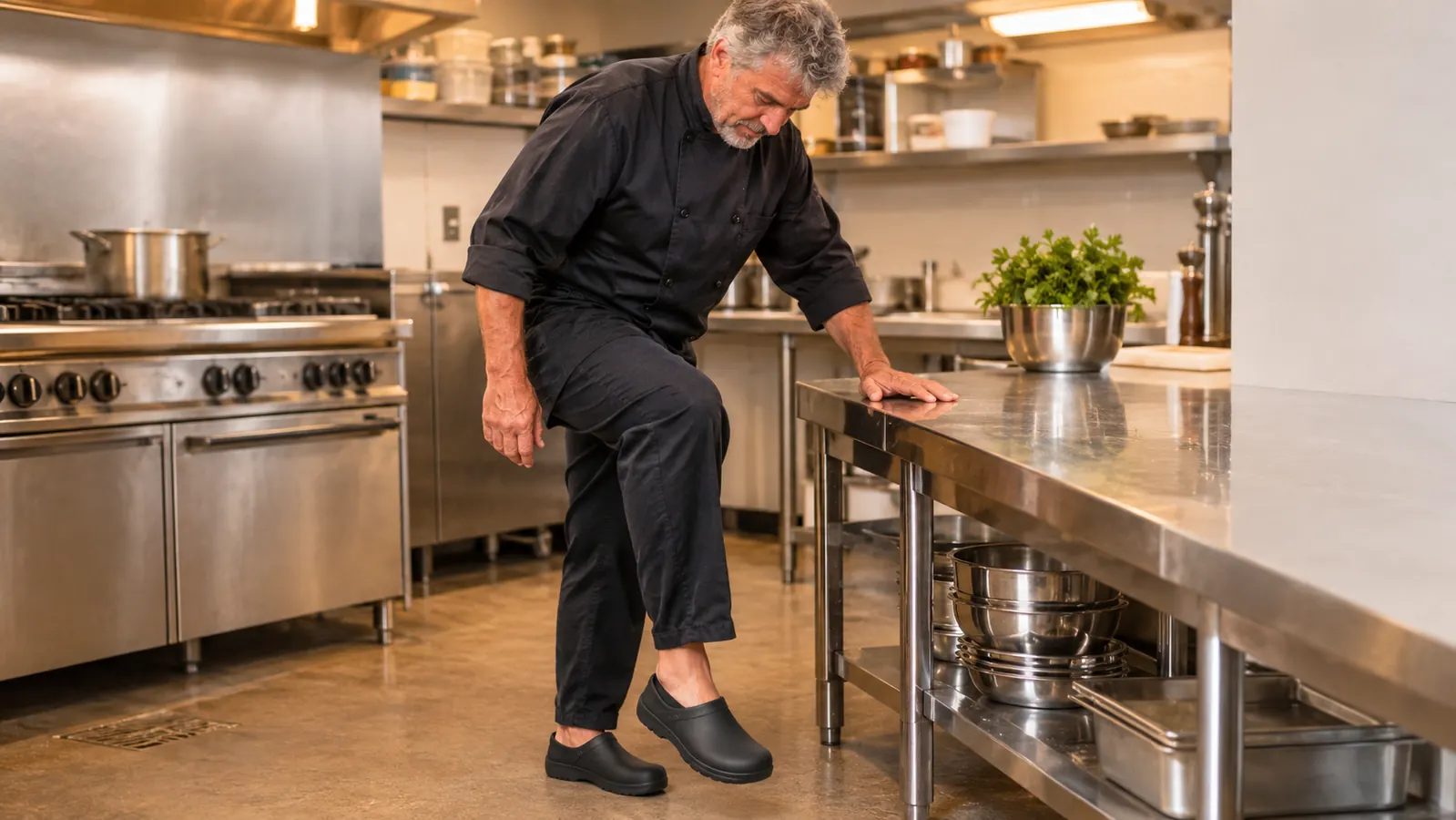
My alarm is 4:45 and I am on the floor by 5:30. There is no sitting down to put shoes on in my routine. The Professional is a pull-on, so it is one foot, then the other, hand on the counter, done. That sounds like a small thing until you have done it in a dark kitchen with a lunch bag under one arm. A shoe that needs two hands and a chair gets worn less often than you think.
A platform heel spreads the load instead of poking at one spot
I spent years in flat sneakers and then years in a cheap pair with a hard heel, and the flat ones were not automatically the kind ones. The heel here is a platform, so you stand on a wider base instead of a thin wedge. On concrete that reads as less of a hot spot under the ball of the foot at hour seven. I will not tell you it makes the floor softer. It changes where the pressure sits, and for me that was enough.
The closed toe survives a cooler door and a dropped case of lettuce
There is a specific morning where you are carrying two cases of romaine through a cooler door and something comes off the top. Closed toe means the thing that lands lands on the shoe and not on your sock. I have had a full deli container come off a cart and hit my foot. I was annoyed. I was not limping. In a store, closed toe is not style. It is a small piece of safety you stop noticing.
The cushioning sits under the part of your heel that complains
My left heel gave me trouble a few years back and my doctor called it plantar fasciitis. It settled with stretching, better shoes and actually taking a day off. I want to be careful, because a shoe is not treatment. What I can tell you is that when I came back, the cushioning sat under the spot that had been complaining, not behind it or beside it. That is a fit question more than a feature question, and it is why I stopped buying work shoes without checking where the footbed actually sat.
Stain resistant is not a marketing word in a bakery
I manage a deli and a bakery. There is shortening, there is cocoa, there is a mister bottle that gets knocked over about once a week. The upper on these is stain resistant, which in practice means a wet rag and thirty seconds at the end of a shift. I am not precious about work shoes. I want them to look like work shoes. But there is a difference between scuffed and disreputable, and this pair has stayed on the right side of that line for a long time.

At 1.5 pounds they stop being something you think about
The listed weight is 1.5 pounds. That lands differently than you would expect, because the weight sits close to the ground. I notice it most at the end of a double, walking out through the back room and across the parking lot. I have owned heavier work shoes that felt fine at nine in the morning and felt like cinder blocks at seven at night. These do not do that to me.
The APMA acceptance is a filter worth using
The Professional is APMA accepted. I am not a podiatrist and I will not pretend a seal is the same thing as a fitting. What I will say is that when you are staring at a wall of shoes at the end of a long week, having an outside body look at the thing is a decent first pass. It narrows the shelf. It does not pick the shoe for you, and anybody who says it does is selling something.
Two pairs, alternating days, is the system that actually works
This is the advice I give most often and it is not about the brand. Buy two pairs of whatever you land on and alternate. A shoe worn five days running never fully dries out, and a damp footbed at 5:30 in the morning is its own small misery. I keep two pairs of Dansko Professionals and swap them day to day. Dale thinks it is funny. My feet do not. It also stretches the life of both pairs.
They read as a shoe somebody chose, not a piece of equipment
I have worked with people in shoes that looked like they came out of a medical catalog, and I have watched those people get comments from customers. A clog does not do that. It looks like a shoe somebody chose. I wear mine into the store, into the bank on the way home, into the post office on a Saturday. Nobody has ever asked me what is wrong with my feet.
The break-in is honest, and that is the whole point
The first week is not comfortable. I say that plainly because I have watched new hires wear a pair for one ten-hour shift and decide they were lied to. Give them short stretches. Wear them for the last two hours of a shift, then four, then the whole thing. Break the shoe in around your foot instead of expecting it soft out of the box. A work shoe that starts soft tends to stop being supportive around month four.
What I'd Skip
If you want something that feels like a running sneaker on day one, skip this. If your shift is mostly sitting, skip it too, because you would be paying for support you are not using. If your job involves jogging across a parking lot or taking stairs three at a time, a clog is the wrong tool and a laced shoe is the right one. And if you are not willing to give it two or three weeks of short stretches, buy something cheaper and flatter, because you will hate these by lunch on day two and blame the shoe. One more thing. If your feet hurt right now, go see somebody before you go shopping. I waited two months on my left heel and I wish I had not.
The only thing I have changed about my feet in twenty-two years that I would do again is two pairs of Dansko Professionals, swapped every other day.
The pair I would hand a new hire on their first morning
Closed toe, cushioned footbed, stain resistant, pull-on. Get them on, then give the break-in two weeks before you wear them for a full shift.
Amazon Check today's price on Amazon →