
The floor behind my deli counter is sealed concrete, and by six in the morning it is already wet in three places: the runoff by the mop sink, the drip tray under the hot case, and the swing of the walk-in door. I have managed this department in Ogden, Utah for 22 years. Ten-hour shifts, five days a week, usually starting at 5:30. The shoes matter more than the apron.
I have been through the cheap non-slip clogs, the stiff work boots, and the running shoes that felt wonderful for three weeks and then went flat. What I actually wanted was simple. Something I could step into at 5:20 in the morning without bending over, something that would not turn into a bar of soap on a wet floor, and something that still felt like a shoe at hour nine instead of a brick. The Skechers D'Lux Walker SR is the closest I have come to all three at once. It is not perfect, and I will tell you exactly where it is not.
The Quick Verdict
A light slip-on that grips a wet floor and saves your back at 5:20 in the morning. The memory foam insole packs down around month four, so plan on two pairs in rotation or a set of replacement insoles.
Amazon Check Today's Price →The shoe that gets me out the door at 5:20 without bending down
Slip resistant, water resistant, and light enough that my knees do not complain on the stairs to the break room. I keep a second pair in rotation so each one dries out between shifts.
Amazon Check Today's Price on Amazon →How I've Used It
I wear a women's 8.5 with a slightly wide forefoot, which is the detail that decides most shoes for me. A narrow toe box and my left pinky toe goes numb by lunch. The Skechers D'Lux Walker SR in my regular size fit with room across the front without feeling sloppy at the heel, and the pull-on tab and stretch panel meant I could get them on while standing up with a bowl of cut fruit in one hand.
I work five days and I keep two pairs of work shoes going, alternating days so each pair gets a full day to dry out. That habit came from a stretch of heel pain in my left foot a few years back. My doctor called it plantar fasciitis and told me what most of us already know: better shoes, stretching, and rest. The shoes are one part of that. They did not fix my foot and I would not tell you they did. What they did was make hour eight of a ten-hour shift less of a negotiation with myself.
For context on what these see in a week: I am on sealed concrete the whole shift. I walk the sales floor, the back room, and the walk-in cooler, and the cooler floor is cold and damp most of the day. There is flour on the bakery side and there is brine on the deli side, and both end up under my feet before the first break. My husband Dale works road construction and thinks I am dramatic about a grocery store floor. Dale has never stood in one spot breading chicken for two hours.
I tried the obvious alternatives first. A pair of slip-resistant clogs that were fine for four hours and then felt like standing in a bucket. A pair of hiking-style work shoes that had real grip but weighed enough that my shins ached on the stairs. Before that I spent two years in cheap running shoes, replacing them every three months, which is a slow way to spend money. The first two weeks in the Skechers pair were unremarkable in the best possible way, which almost never happens with a new work shoe.
The 5:20 A.M. Test and What a Pull-On Actually Saves You
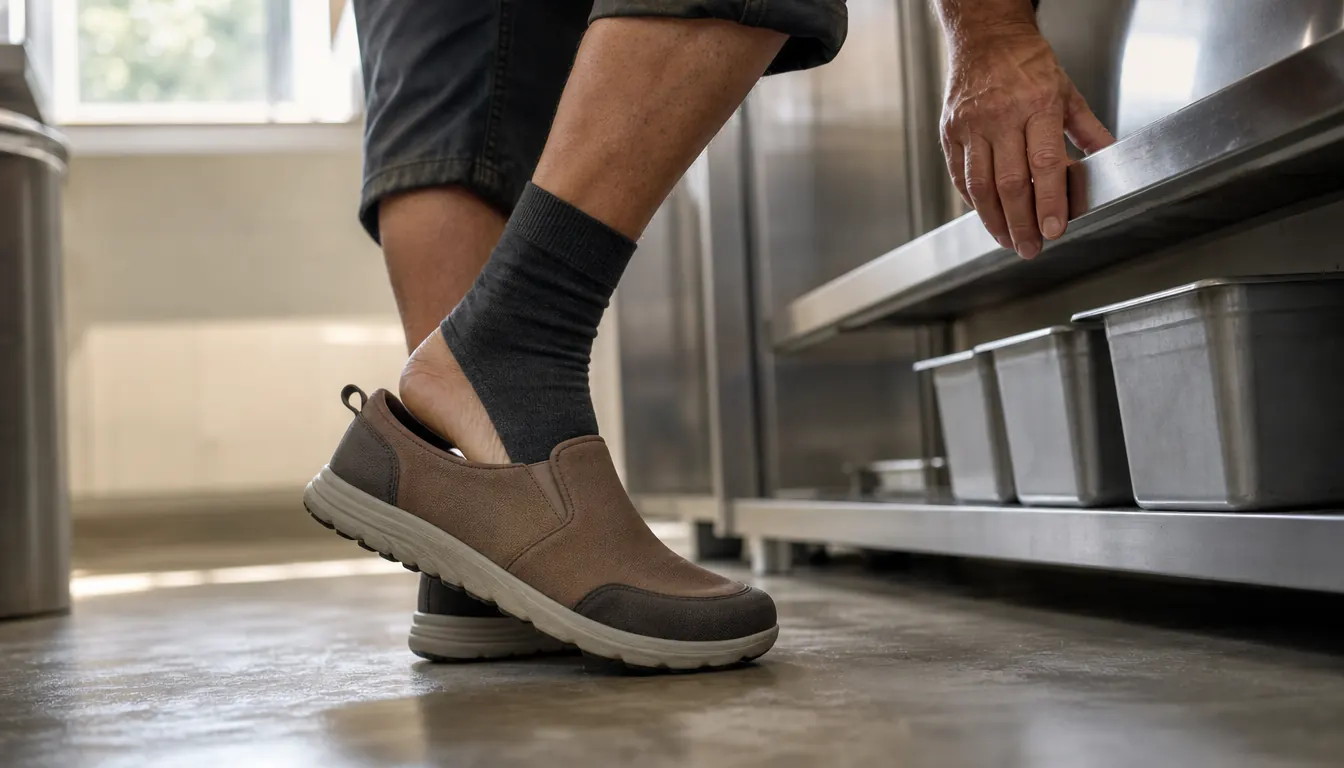
People who have never worked a shift that starts before dawn do not understand why the closure type matters. At 5:20 in the morning I am not sitting on a bench tying laces. I am standing in the dark entry of a store with a lunch bag in one hand and a coffee in the other, and I want to be inside the building in one motion. The pull-on design is the reason I bought these in the first place, and it is the reason I will buy them again.
It is not just the mornings either. By the end of the shift my feet are warm and slightly swollen, the way feet get after ten hours of standing, and bending down to untie anything is the last thing on earth I want to do. Stepping straight out of a slip-on at four in the afternoon is a small kindness I notice every single day, and I have stopped taking it for granted.
There is a tradeoff and I will say it plainly. A slip-on does not lock your heel down the way a laced shoe does. I ended up going down half a size after the first week, because the 9 slid at the back when I turned quickly at the slicer. The 8.5 stays put. If you are between sizes, take the smaller one and give it a couple of shifts before you decide.
On a Wet Floor, Which Is Most of the Day
Slip resistance is the whole reason a deli worker buys a work shoe instead of a walking shoe. My floor is wet more often than it is dry. The mop goes down at close and again mid-afternoon, the ice machine drips, and the tile by the hand sink is slick all day long. I have gone down once in 22 years, on a pair of smooth-soled clogs, and I have no interest in repeating it.
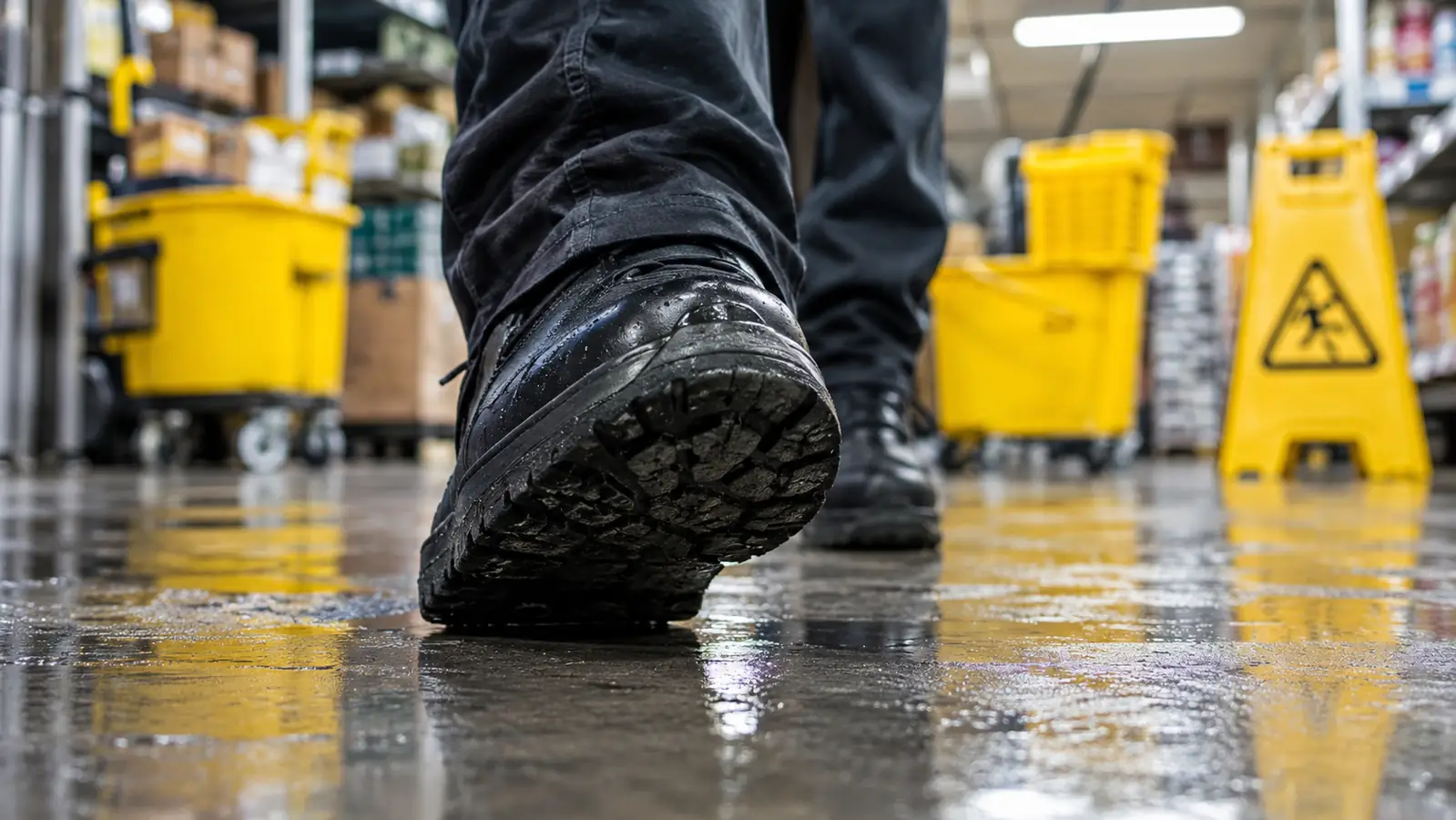
The outsole on the D'Lux Walker SR has a tread pattern that bites on wet sealed concrete. I have tested it on the worst spot in the department, the little slope in front of the walk-in where water pools after the mop, and it holds. It also handles a small spill of canola oil if you catch it within a minute, which is about how fast anyone catches anything in a working kitchen.
Here is the test that convinced me. In February the drain line under the three-compartment sink backed up during the lunch rush and put a sheet of water across roughly eight feet of floor between the sink and the hot case. I was the one who went for the mop. I crossed that floor four times with the mop and bucket and never lost my footing, on a floor that had put two people down in my memory. That is not a laboratory test. It is the only test that matters to me.
The water resistant upper helps with the constant small soakings, which is most of what a grocery floor throws at you. A splash from the sink, a wipe down with a wet rag, the spray off a hose in the back room. These are not waterproof shoes. If you stand in standing water for an hour, your socks will get wet, and I would rather tell you that than have you find out on a Tuesday. For ordinary damp they are enough, and they dry overnight when you rotate.
The outsole holds on the slope in front of the walk-in where water pools after the mop, which is the one spot in my department that has put people on the floor.
The Memory Foam Question
The insole is memory foam, and I want to be honest about what that means, because the internet has gotten strange about it. Out of the box it feels like a lot of cushion. It is soft, and it is comfortable in a way that made me suspicious, because soft shoes usually quit on you around week six.
That is roughly what happened here. The foam compressed under the ball of my foot and my heel and stopped springing back somewhere around month four. I noticed it on a Saturday, our busiest day, when I caught myself shifting weight from foot to foot by mid-afternoon like a kid who needs the bathroom.
The shoe did not become bad. The upper was still fine and the outsole still had tread on it. It just stopped being a cushion and became a container. My fix was a set of firmer replacement insoles, which cost less than a new pair of shoes and bought me several more months of comfortable shifts. The other fix is the one I already use, which is keeping two pairs so no single pair takes five days of compression a week. If you plan to wear one pair five days a week and expect the factory insole to last a year, it will not, and that is true of every memory foam shoe I have owned.
I tried a gel insert first, because it was in the drawer at home, and it was the wrong call. Gel feels good for about ten minutes and then it bottoms out under a heel, and by the end of one shift my heel was complaining in the way it used to. A flat firmer foam insert worked better. Nothing glamorous, just denser foam with a little shape at the arch, trimmed with kitchen scissors to fit the footbed. That is what is in both pairs now.
Weight, Fit, and a Wide Forefoot
Skechers lists the weight at 2 pounds, and in the hand they feel lighter than the work shoes I wore before. That sounds like a small thing until you have lifted your foot something like 20,000 times in a shift, which is close to what a day on the deli line adds up to. Lighter shoes at hour nine are a completely different purchase decision than lighter shoes in the store aisle.
The fit runs a touch generous, which is the Relaxed Fit part of the name. For my slightly wide forefoot that was the entire point. My toes had room to spread and I never got the numb pinky toe that narrow toe boxes give me. The heel is where you have to pay attention, as I said, so try your true size and the half size down if you can get to a store.
The arch is described as cushioning rather than supportive, and that matches what my feet reported back. There is no hard shank in here and nothing posting your arch up. If you need genuine arch support, plan on an insert from day one instead of waiting until month four to admit it.
Where It Wears Out First
After several months of rotating two pairs, the wear pattern is consistent on both of them. The outsole at the outer heel goes first, which is normal for anyone with a slight outward roll. The memory foam insole goes second. The upper, including the stretch panel at the instep, has held up better than I expected, with no separation at the toe and no split where the pull tab attaches, which is where cheap slip-ons usually fail on me.
By month six the outer heel on the pair I wear Mondays, Wednesdays and Fridays had worn through the surface texture into a smooth patch about the size of a quarter, and the tread across the ball of the foot had flattened but not disappeared. The pair on the other days was a few weeks behind. Compare that to the laced work shoes I wore before, which had separation at the toe cap by month five on both feet. No shoe survives this floor forever, but these go out on their tread and not on their seams.
Cleaning is easy, and in food service that counts for more than people give it credit for. A damp cloth takes off flour and marinade and I have never had a stain set in. The inside is the part that gets ripe after a few months of ten-hour shifts, and the rotation is what saves you there. Two pairs, alternating days, no exceptions.
What I Liked
- Pull-on design means no bending over at 5:20 in the morning or at the end of a shift
- Tread grips wet sealed concrete, including the sloped spot by the walk-in
- Light at a listed 2 pounds, which you feel at hour nine
- Water resistant upper shrugs off splashes and wipes clean with a rag
- Relaxed Fit leaves real room across a wide forefoot
Where It Falls Short
- Memory foam insole compresses by about month four, so budget for replacement insoles
- Slip-on heel does not lock down like laces, some people need a half size down
- Cushioning arch rather than a supportive one, no built-in arch support
- Water resistant is not waterproof, standing water gets through
- One pair worn five days a week will not make it a full year
Who This Is For
If your shift is ten hours on a hard floor and you are in and out of a wet area all day, the Skechers D'Lux Walker SR is a sensible buy. It suits deli and bakery counters, grocery floor staff, cafeteria and kitchen workers, warehouse pickers, and anyone who wants to step into a shoe in the dark and forget about their feet until the break bell. It also suits the person who has already figured out that two pairs in rotation outlast three pairs worn to death one at a time.
Who Should Skip It
Skip it if you need genuine arch support, because this is a cushioning shoe and it will not hold your arch up on its own. Skip it if your workplace actually floods, since water resistant does not mean waterproof. Skip it if you want to buy one pair and not think about shoes again for two years, because the insole will not go the distance and you will be shopping for inserts by spring. And skip it if you have a narrow foot, because the Relaxed Fit will feel like a bucket on you.
Two pairs in rotation outlasted every single pair I tried to stretch
Slip resistant outsole, water resistant upper, and a pull-on fit that saves your back before the sun is up. Order your true size or a half size down, and pick up a set of firmer insoles while you are at it.
Amazon Check Today's Price on Amazon →