
The first thing I noticed about the Brooks Addiction Walker 2 was not the cushioning. It was that at hour seven of a ten-hour shift, I had not thought about my feet once. That almost never happens. I manage the deli and bakery at a grocery store in Ogden, Utah, and I have spent 22 years on sealed concrete, clocking in at 5:30 in the morning, five days a week.
Most work shoes announce themselves. They squeak at the little toe, they go flat by the fourth month, and you start doing that thing where you shift weight from one foot to the other while pretending to listen to somebody explain exactly how they want a sandwich cut. The Addiction Walker 2 mostly stays quiet. It is a lace-up walking shoe with a closed toe and a BioMoGo DNA insole, and Brooks built it for the kind of day I actually have: standing, walking the floor, ducking into the back room and the walk-in cooler, then standing again.
The Quick Verdict
Heavy, warm, and plain to look at, but the support is still there past month six on concrete. That is more than I can say for anything else I have worn behind this counter.
Amazon Check Today's Price →Ten hours on concrete is the test. This is the pair that passed it.
Firm support under the arch, a closed toe, and the non-slip outsole Brooks advertises on the listing. I keep a second pair in the back room so each one gets a full day to dry out.
Amazon Check Today's Price on Amazon →How I've Used It
Five days a week, 5:30 in the morning until a little after three. My day is not walking in the fitness sense. It is four or five miles of short trips: counter to walk-in cooler, cooler to the prep table, prep table out to the floor to answer a question about a cake order, then back again. The rest of it is standing in one spot, and standing in one spot is the part that hurts. On a Thursday in March I counted it out of curiosity, with the step tracker on my phone in my apron pocket. Nearly nine thousand steps, and not one of them longer than about forty feet.
I keep two pairs of work shoes and alternate days so each pair gets a full day to air out. Deli work is damp work. There is wash water, there is a mop bucket that follows me around, and there is flour on everything by nine in the morning. Rotating is not a shoe-reviewer habit, it is how you get a year out of a pair instead of five months. Both of my pairs are this same model, one bought in the spring and the second in the fall, and I can tell the older one apart by the crease across the toe box.
Before these I spent a long stretch in clogs, and before that in whatever athletic shoe was on sale that month. The clogs were easy on and easy off and I liked them for the first three hours. Then the sole would start to feel like standing on a cutting board, and my heel would slide toward the inner wall of the clog and stay there. The sale athletic shoes were the opposite problem. Soft, light, comfortable in the store, and by two in the afternoon I could feel that the midsole had given up and my arch was doing all the work. What I wanted was not complicated: laces, a closed toe, and enough structure that my foot was not sliding around inside the shoe by noon. That is a short list, and the Addiction Walker 2 is one of the few shoes I tried that hit all three.
What the Support Actually Feels Like
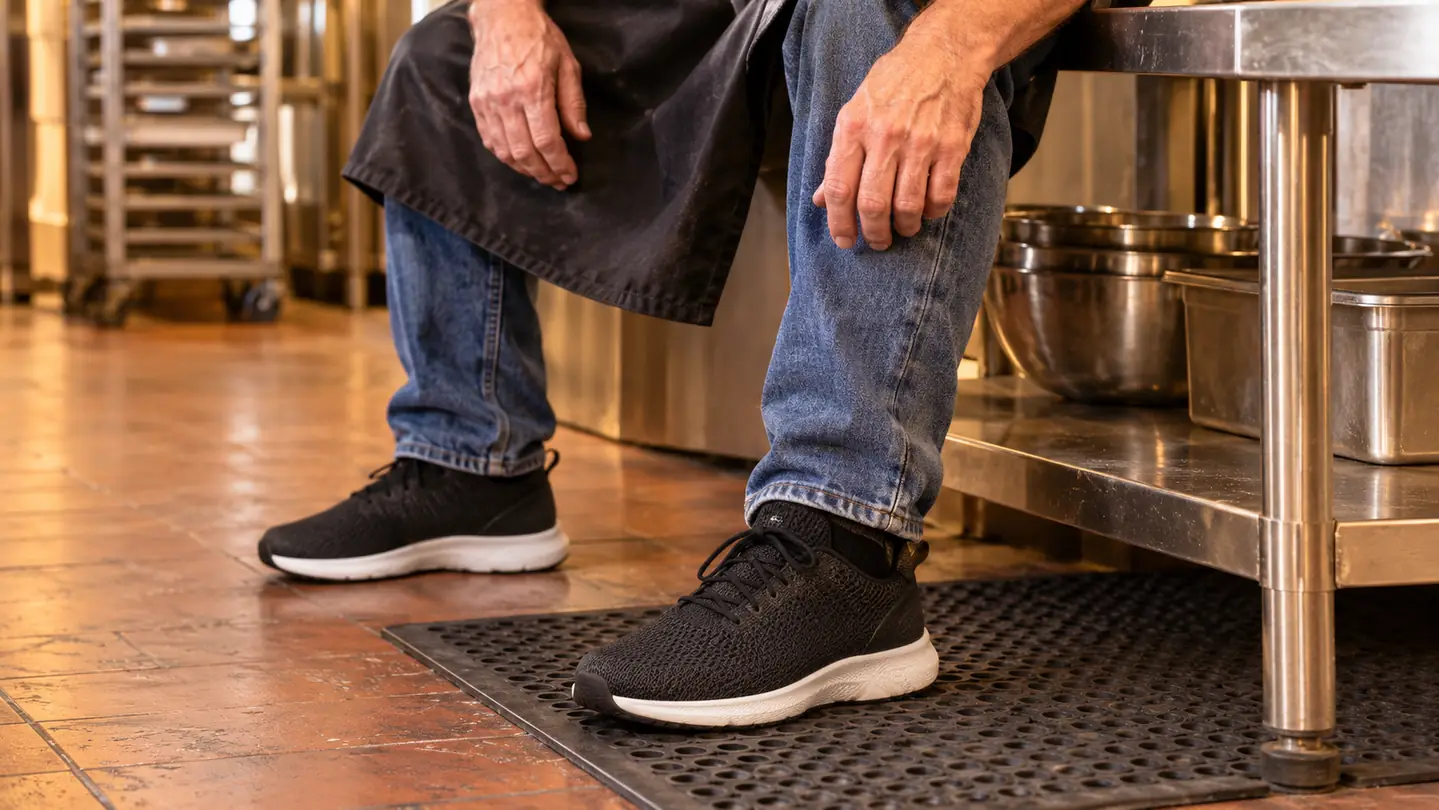
The midsole is firm. Not hard, firm, and it took me about a week to stop wanting something softer. Soft shoes feel wonderful at eight in the morning and useless by two in the afternoon. What this shoe does instead is hold the arch and keep my foot from rolling inward, so my foot is doing less work with every step. By the end of the shift my feet are tired, but they are tired in a normal way instead of a swollen way.
The BioMoGo DNA insole is the part directly under the foot, and it has a little give without turning to mush. I want to be careful here and not overpromise. This is not a shoe that fixed anything for me. I had heel pain in my left foot a few years back, the first-steps-in-the-morning kind, and my doctor called it plantar fasciitis. It settled down with stretching, better shoes and time off my feet, and I have been careful with it since. What I notice with these is that my feet are less beaten up at the end of a week than they were in clogs. That is the whole claim I am making. Comfort and support, nothing more.
Break-in took me about two weeks. The upper is stiff out of the box and it creased across the top of my foot in a way I did not love for the first several shifts. I wore them for three evenings around the house before I took them to work, which helped a little, and then I put up with the crease until it softened. It did soften. By the third week the upper had shaped itself around my foot and I stopped noticing it. If you are the kind of person who needs a shoe to feel right on day one, plan on a week of evenings in them first, and do not judge them on the first shift.
On Wet Tile and in the Walk-In Cooler
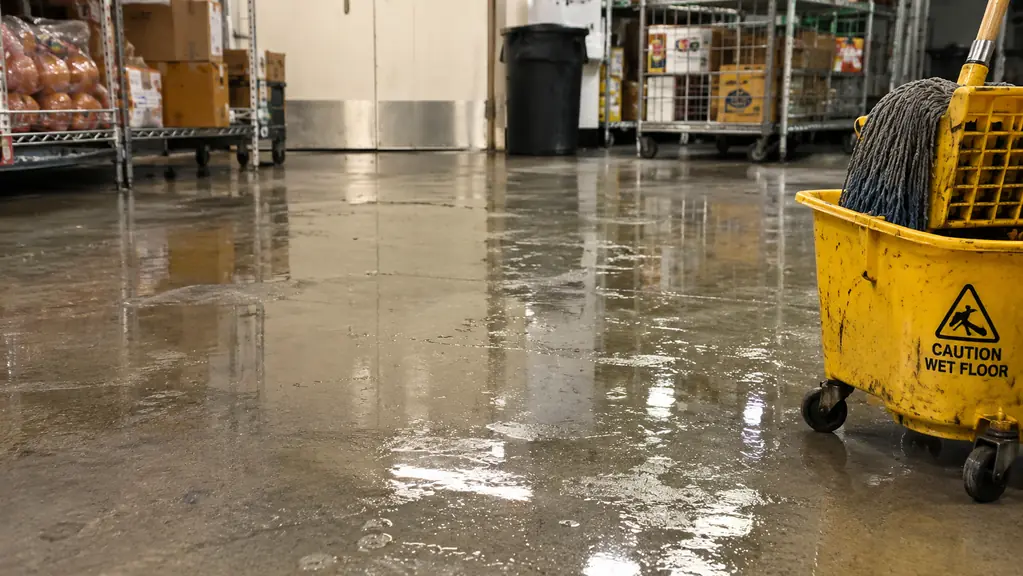
Brooks calls the outsole non-slip, and my honest read after months of use is that the claim holds where I need it to. Wet tile, mopped concrete, the little puddle that is always just inside the cooler door: I have not gone down. What it does not do is grip on a film of oil, or on loose flour, or on a grape someone dropped. No shoe does. Walk like the floor is guilty until proven otherwise.
Water resistance is where I have to be straight with you. The listing says not water resistant, and that is accurate. The walk-in cooler is fine, that is cold and dry. But a wet parking lot in February or a mop bucket catching the toe will soak through the upper, and once the upper is wet it stays wet for hours. I learned that on a snowy Tuesday in January, walking in from the employee lot through slush, and my right foot was damp until lunch. I keep a spare pair of socks in my bag now, and in winter I change them at the start of the shift whether I think I need to or not. That is not a complaint, it is just the tradeoff you are buying into.
These are warm shoes. Closed toe, solid build, no mesh to breathe through. In an air-conditioned store that is fine all year. In August, with the ovens going and the bread cooler humming, you will notice them sitting on your feet. I still wear them, because the alternative is a lighter shoe that leaves me sore by noon. I just notice, and I take my break outside where there is a breeze.
How They Held Up Over the Months
Wear shows first at the outer edge of the heel, which is where every shoe I own wears first. I started this pair in the fall, and by month six the tread there was smoother but not gone, and the rest of the outsole still had its pattern. At eight months the heel edge is rounded off and the tread under the ball of my foot has thinned, but the shoe still has its structure and I am not yet shopping for a replacement. That is a longer life than I got out of the athletic shoes I used to buy, which were lucky to make four months before the heel felt like a folded piece of cardboard under my foot. The pair I bought first is further along than the newer one, and the difference between them is mostly in the insole.
The upper has held its shape. The laces were the first thing to go, and I replaced them with a longer pair because I like to double-knot. The insole packed down some around month five, which I expected. It did not go flat, it just got a little less springy under the ball of my foot.
The weight is the thing people bring up in reviews, so let me bring it up. Brooks lists a shoe at 1 kg, and after years in a light clog you will feel that on the first few shifts. I got used to it in about a week. What I did not get used to is how much less my feet hurt at the end of that week, which is the whole point of the trade. Weight is the price of structure here. If your knees or hips have been bothering you and someone has told you to keep your shoes light, that is a conversation to have before you order, not after.
Sizing and the Wide Forefoot Question
I wear a women's 8.5, and my forefoot is slightly wide. These fit true to size for me with room across the toes, which is not always the case with a structured upper. If you are between sizes, I would stay with the smaller one, because the upper does relax over the first month. If you have a genuinely wide foot, this is one of the few walking shoes where I would not automatically tell you to size up. The pair in my rotation that fits best is the one I bought in my normal size rather than the half size up.
The heel was the part that gave me trouble in week one. There is enough room back there that my heel lifted slightly on the first few steps until I re-laced from the bottom and pulled the top two eyelets a little tighter. After that it locked in and I stopped thinking about it. If you have a narrow heel, budget a few days for that fiddle, and try the lacing change before you decide the shoe is wrong.
The other sizing note is socks. I wear a cushioned crew sock year round and the fit is right with that. In thin socks the shoe felt loose across the top of my foot, and I could feel my foot moving inside it on the tile. Try them on with the socks you actually work in, not the ones you wear on the weekend.
What I Liked
- Firm support still holding past month six on sealed concrete
- Non-slip outsole grips wet tile and mopped floors
- Closed toe and lace-up, so nothing slides around by noon
- True to size with real room across the toes
- Upper keeps its shape and the outsole wears slowly
Where It Falls Short
- Heavy at about 1 kg, noticeable the first week
- Not water resistant, and a wet upper stays wet for hours
- Warm in a hot kitchen in summer
- Two-week break-in on the upper
- Heel lifted in week one until I re-laced
Support is not the same thing as softness. Soft shoes feel wonderful at eight in the morning and useless by two in the afternoon.
Who This Is For
If you stand on a hard floor for eight to twelve hours, this shoe is built the way your day is built. Nurses, grocery and retail staff, warehouse pickers, kitchen crews, hairstylists. I would especially point you here if you are carrying extra weight, because the firm midsole does not collapse under you the way a soft shoe does by mid-shift. It is also the shoe I would hand to someone who has been told they need more support and does not want to guess what that means.
It suits anyone who wants a real lace-up with a closed toe, too. If your workplace allows laces and you are tired of your foot sliding forward into the end of the shoe by afternoon, this is the fix.
Who Should Skip It
Skip it if you want a light, flexible shoe. You will feel the weight, and no amount of break-in changes that. Skip it if your day is wet from start to finish, in a dish pit or a car wash or out in a yard, because an upper that is never dry is a bad time for your feet and for the shoe. Skip it if you want maximum softness underfoot. And skip it if you need to slip shoes on and off a dozen times a shift, because these are lace-up and the laces are the whole point.
I would also skip it if you have a narrow forefoot and a narrow heel. The shoe runs generous, and you will spend the day lacing to compensate for it.
Eight months in, I still reach for these at 5:20 in the morning
That is the whole recommendation. Firm support, a closed toe, non-slip tread, and a pair that still has tread left on it. Check the size chart on Amazon before you commit to a size, since these run true with room in the toe.
Amazon Check Today's Price on Amazon →