
Short answer: if your shift is mostly standing on sealed concrete, the Brooks Addiction Walker 2 is the better work shoe for most people. Running shoes are the better choice for a smaller group, the ones who walk most of the shift and need less shoe under them. I am Renee Halvorsen. I manage the deli and bakery at a grocery store in Ogden, Utah. I have spent 22 years on 10-hour shifts, usually starting at 5:30 AM, five days a week. I have worn both kinds of shoe on that floor. The Brooks is not a perfect shoe. It is a walking shoe with a closed toe, lace-up closure, BioMoGo DNA insole cushioning and a non-slip outsole. Those four things matter more on concrete than most running shoe features.
Here is the part that makes this comparison less one-sided than shoe marketing suggests. Running shoes are not bad shoes. They are built for a different job. If you walk most of your shift, if you move fast through a warehouse or a hospital corridor, if your feet run hot, a running shoe can feel lighter and cooler than the Brooks. The question is not which shoe is better in general. The question is which shoe is better for the work you actually do. I have watched coworkers buy running shoes because they felt good in the store, then struggle through the last two hours of a shift. I have also watched coworkers in running shoes cover six miles a shift and feel fine. The difference was the job, not the shoe.
| Brooks Addiction Walker 2 | Running Shoes for Work | |
|---|---|---|
| Main job | Standing and walking on hard indoor floors | Running and forward motion |
| Underfoot feel | Firm, steady cushioning from the BioMoGo DNA insole | Softer, springier foam that feels softer at first |
| Grip on wet grocery floors | Non-slip per the listing | Varies by shoe, many have smooth tread |
| Weight | 1 kg per the listing | Usually lighter |
| Airflow | Closed toe and listed as not water resistant | Mesh uppers often breathe better |
| Flex in the forefoot | Stiffer, less roll | More flex and easier toe-off |
| Support over a 10-hour shift | Firmer platform that holds its shape | Soft foam can compress and feel vague |
| Durability on concrete | Heavier walking shoe build | Light foam and thin tread wear faster |
| Break-in | A few shifts to soften | Usually comfortable right away |
| Water resistance | Not water resistant | Not water resistant |
| Closure | Lace-up | Mostly lace-up |
| Best for | Mostly standing | Mostly walking |
How I Compared Them
I did not run a lab test. I wore the Brooks Addiction Walker 2 on my own shifts, and I compared it with the running shoes I and my coworkers have worn at the store. My shifts are 10 hours, five days a week, on sealed concrete. I walk the sales floor, the back room and the walk-in cooler. I stand at a slicer, a counter and a bench. That mix is the test. A shoe that feels good for a 20-minute try-on can still be wrong by hour eight. I paid attention to three things: how my feet felt at the end of the day, how the shoe handled a wet floor, and whether the cushioning still felt like cushioning after a week.
The Brooks listing gives me a short set of facts to work from. It is a women's walking shoe with a lace-up closure, a closed toe, cushioning, a non-slip outsole and BioMoGo DNA in the insole. It is listed at 1 kg. It is not water resistant. The average rating on the listing is 4.2 across more than 4,000 reviews. That is not a perfect score, and I would not trust a perfect score on a work shoe. A firmer shoe will always have people who want more softness. I am one of the people who wants the firmness. That is the lens I am using here.
I started this in the second week of March, which is a rough month in a grocery store. Spring rain comes in on everybody's shoes and the floor by the front end stays damp from open to close. That gave me a fair look at grip without arranging anything. I wore the Brooks four shifts in a row, then went back to a running shoe for two, and wrote down how my feet felt at 3:30 in the afternoon, before the last stretch of the day.
Where Brooks Addiction Walker Wins
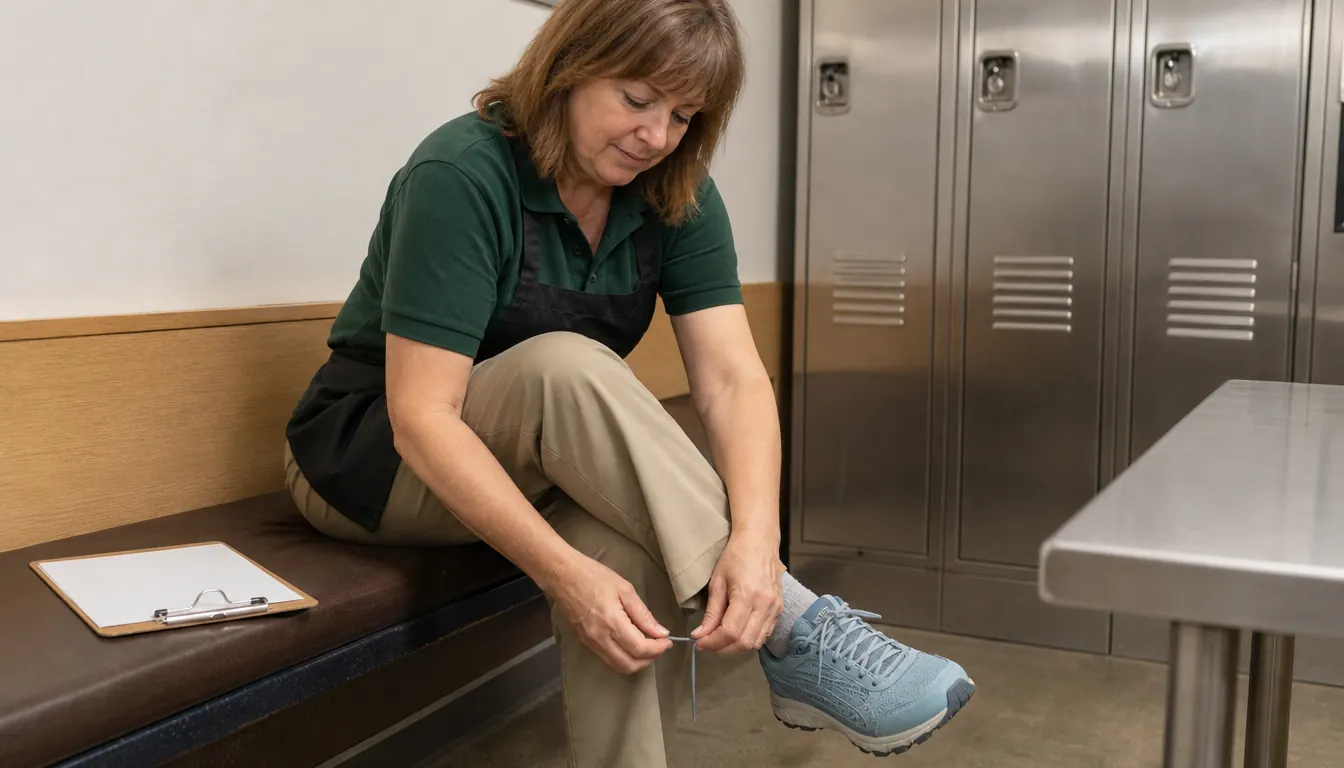
Grip is the first win. The Brooks listing calls the shoe non-slip, and that matters in a grocery store. There is spilled juice, tracked-in rain, flour dust from the bakery and a walk-in cooler floor that gets slick. A running shoe with a thin, smooth tread is not built for that. The Brooks has a closed toe and a lace-up fit that keeps the shoe from sliding around when I turn a corner with a tub of salad. I am not saying it will keep you upright on ice. I am saying it is built for the kind of floor I work on. When I wear a shoe with a smoother sole, I shorten my steps without thinking about it. That is a bad sign.
The week I tested, someone dropped a half gallon of orange juice by the dairy case and it ran under the matting. I walked through that spot twenty minutes later in the Brooks and felt the sole hold. A month earlier I had been in a running shoe with a worn heel and I took a short step and caught myself on the corner of a display. Nothing dramatic. Just enough to make me careful for the rest of the shift.
The second win is the cushioning. The Brooks uses BioMoGo DNA in the insole, and the listing calls it cushioning. What I care about is how it feels at hour eight. Running shoe foam is often softer and springier at first. That feels great when you try it on in the store. By the end of a long shift, soft foam can compress and leave you feeling like you are standing on a board. The Brooks is firmer from the start and stays closer to that firmness. It is not plush. It is steady. I rotate two pairs so each one dries out, and that habit matters as much as the shoe. A dry shoe is a more supportive shoe.
Where Running Shoes Win
I will give running shoes their due. They are usually lighter than the Brooks, which is listed at 1 kg. On a day when I am walking the whole store, from the back room to the cooler to the front end, that lighter weight is real. Running shoes also breathe better. The Brooks has a closed toe and is listed as not water resistant. On a hot day in the bakery, a mesh running shoe moves air in a way the Brooks does not. If your feet swell or run hot by noon, that is not a small thing. I have had days when I wanted the airflow more than I wanted the firmness.
Last summer I spent a week in a mesh running shoe during a heat wave and the difference was obvious by noon. The bakery runs close to 90 degrees when the ovens are going and the air conditioning cannot keep up. My feet stayed drier. I also stopped noticing the weight, which is the point. At 1 kg the Brooks makes itself known on a long day.
Running shoes also flex more. They are built to roll through a stride, and that makes them easy to walk in right out of the box. The Brooks took me a few shifts to soften up. Not a long break-in, but it is not a shoe that feels perfect on day one. If you have a job where you are moving constantly and you do not need a firm platform, a running shoe can be the more comfortable choice. I have had coworkers who swore by their running shoes and would not switch. They were also the ones walking six or seven miles a shift, not standing at a slicer. The shoe matched the job.
If your shift is mostly standing, start with the Brooks Addiction Walker 2
The Brooks is built as a walking shoe with cushioning, a closed toe, lace-up closure and a non-slip outsole. If you are on sealed concrete for 10 hours, that is the combination I would try first.
Amazon Check Availability on Amazon →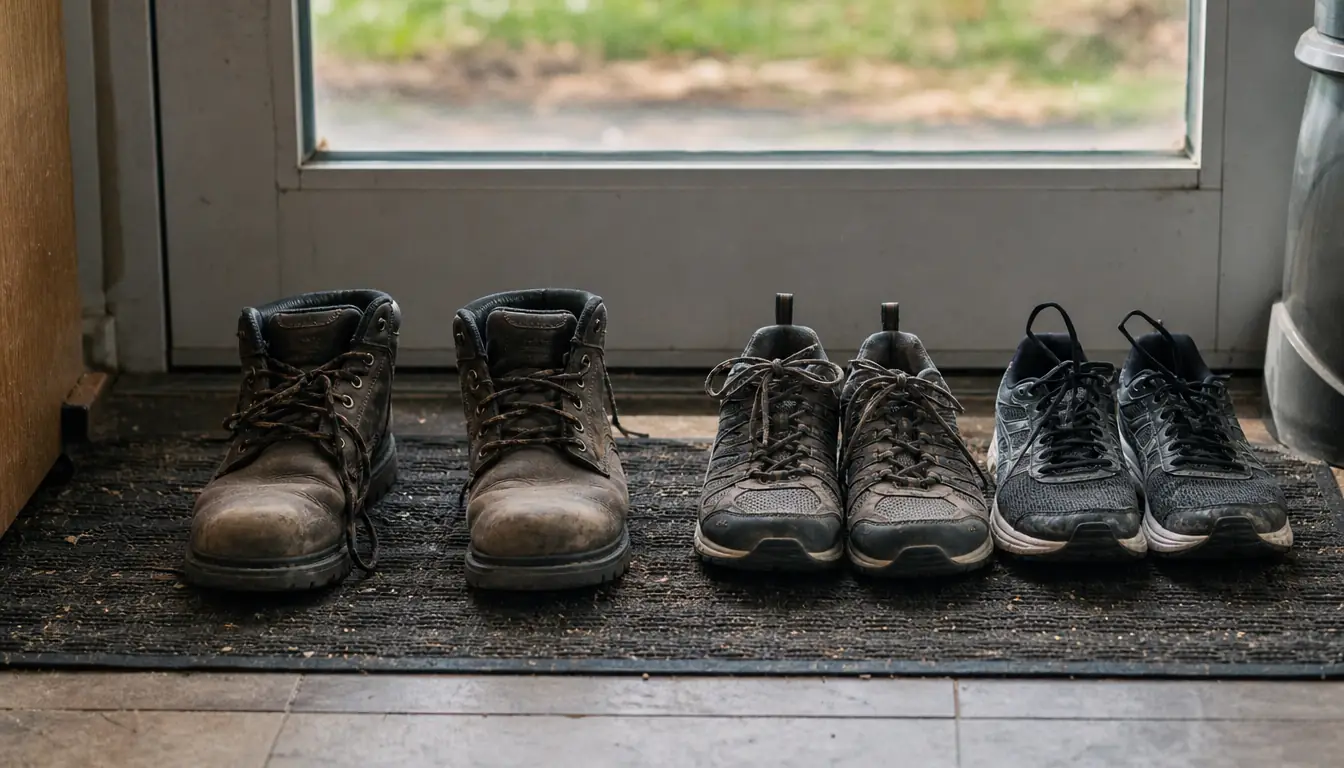
The Tradeoffs I Noticed
The Brooks is not a light shoe. At 1 kg, it has some heft. On a day when I am doing a lot of stair climbing or running to the front end for a label check, I feel it. The closed toe and the general build also mean less airflow. In July, the bakery gets hot, and I notice the difference. The shoe is not water resistant, so a wet floor or a spilled bucket can soak through. I keep a dry pair in my locker on rainy weeks. That is not a flaw unique to the Brooks. It is a flaw in most work shoes that are not built as waterproof boots.
The running shoe tradeoff is the opposite. You get less weight and more airflow, and you give up some structure. A soft running shoe can feel great for the first mile and vague by hour six. The tread is often thinner, which is fine on a track and less fine on concrete with spills. The upper is often mesh, which breathes and also lets water in. I am not saying running shoes are fragile. I am saying they are built to a different budget of weight and durability. If you go that route, get a pair with some texture on the bottom and replace them when the midsole starts to feel flat.
I wore out one pair of running shoes in about five months when I was covering the whole store. The midsole went flat first, long before the tread wore through, and I did not notice until my knees started complaining on the stairs. That is how running shoe foam fails. Quietly.
What the Rating Does and Does Not Tell You
The Brooks listing shows 4.2 stars across more than 4,000 reviews. That is a useful number and a limited one. It tells you the shoe works for a lot of people. It does not tell you whether those people stand for 10 hours or walk six miles. A running shoe can have a great rating and still be wrong for a deli counter. A walking shoe can have a good rating and still be too firm for someone who wants a soft ride. I read the low reviews on work shoes for one thing: complaints about the shoe feeling heavy or stiff. On the Brooks, those complaints make sense. It is a firmer shoe. If you want a pillow, this is not it.
The rating also does not tell you about fit over a long day. My feet are a women's 8.5, slightly wide in the forefoot. The lace-up closure on the Brooks lets me adjust across the top of the foot. I do not have a width option listed in the specs I have, so I am not going to pretend I tried one. I can tell you that the lace-up matters. A shoe that is too tight across the forefoot will make a 10-hour shift feel longer. A shoe that is too loose will let your foot slide. The Brooks has enough adjustment for me. That is all I can claim.
Who Should Buy Which
Buy the Brooks Addiction Walker 2 if your shift is mostly standing. If you work a register, a deli counter, a bakery bench, a lab bench or a security desk, and your steps are short and frequent rather than a long continuous walk, the Brooks is the safer bet. It is also the shoe I would pick if you have had foot pain in the past and you want a firm platform under you. I had a bout of heel pain years back that my doctor called plantar fasciitis. It settled with stretching, rest and better shoes. I am not going to tell you a shoe fixed it. I am telling you that a firm walking shoe was part of what made my shifts easier.
Buy running shoes if you walk most of your shift and you do not have a lot of standing still. If you are a nurse on a hospital floor, a warehouse picker, a server or someone who covers a lot of ground, a running shoe can be lighter and cooler. Get one with a tread that has some texture, not a smooth racing sole. And replace them sooner. Running shoe foam is not built to last years on concrete. The Brooks is not either, but the heavier build holds up longer in my experience. I keep two pairs of the Brooks and alternate days. That is the habit I would keep no matter which shoe you choose.
The walking shoe I keep on my own rotation
After 22 years on concrete, I do not need a shoe that feels exciting in the store. I need one that feels the same at hour eight. The Brooks Addiction Walker 2 is that shoe for me.
Amazon See the Brooks Addiction Walker 2 on Amazon →