Somebody in the break room asked me last month whether the Crocs Bistro was actually worth buying, and I gave her the short answer I give everybody. It depends on what your floor is made of and how long you stand on it. I'm Renee Halvorsen. I run the deli and bakery at a grocery store in Ogden, Utah, and I've spent 22 years doing 10-hour shifts on sealed concrete. I clock in at 5:30 in the morning, five days a week. That number, 10 hours, is the only spec that matters when you're shopping for work shoes.
Most work shoes sold to people like us are built around a feature list. Slip resistant outsole. Waterproof upper. Easy to wipe down. All of that is true and none of it tells you what your feet will feel like at hour nine. So I've worn a pair of Crocs Bistro clogs through a long stretch of shifts, rotating them with my second pair the way I always do, and what follows is what actually changed for me. Including the parts I don't like.
The Quick Verdict
A light, wipe-clean clog that handles a wet deli floor better than most things in its category. Not enough under the arch for everybody, and the fit runs roomy enough that sizing matters.
Amazon Check Today's Price →The clog that survived my dish pit
Closed toe, slip resistant, waterproof, 16 ounces. Half the deli crew wears a pair now, and I started it.
Amazon Check Today's Price on Amazon →How I've Used It
I bought my first pair because the shoes I'd been wearing were coming apart at the seam where the counter edge hits the toe. I keep two pairs of work shoes and I alternate days so each pair dries out. The Crocs Bistro became one of those two, which puts me in them two or three shifts a week. Call it somewhere north of 300 shifts by now, across wet closes and dry mornings and one memorable week when the walk-in cooler drain backed up.
My route on any given day is the same. I walk the back room, pull product out of the walk-in cooler, work the prep counter for the first three hours, then move to the front case and the register. There is water on the floor near the dish pit most mornings. There is flour on the floor near the bakery side. There is a rubber mat in front of the slicer that catches everything. That's the obstacle course, five days a week, and it has not changed in two decades.
I keep track of things without meaning to. Last March I clipped a step counter on out of curiosity on a plain Tuesday and forgot about it until close. 14,200 steps, which works out to somewhere around six miles, and most of it on the same forty feet of floor between the prep counter and the front case. That is what these shoes are actually being asked to handle. Not a hike. The same short loop, over and over, on a surface with no give in it at all.
The first week I noticed the weight before anything else. Sixteen ounces per shoe is not a heavy shoe, and the difference shows up at the end of the day when you're lifting your feet instead of dragging them. The second thing I noticed was how little I had to think about them. No laces to retie with wet hands. Nothing to break in the way a leather work shoe breaks in.
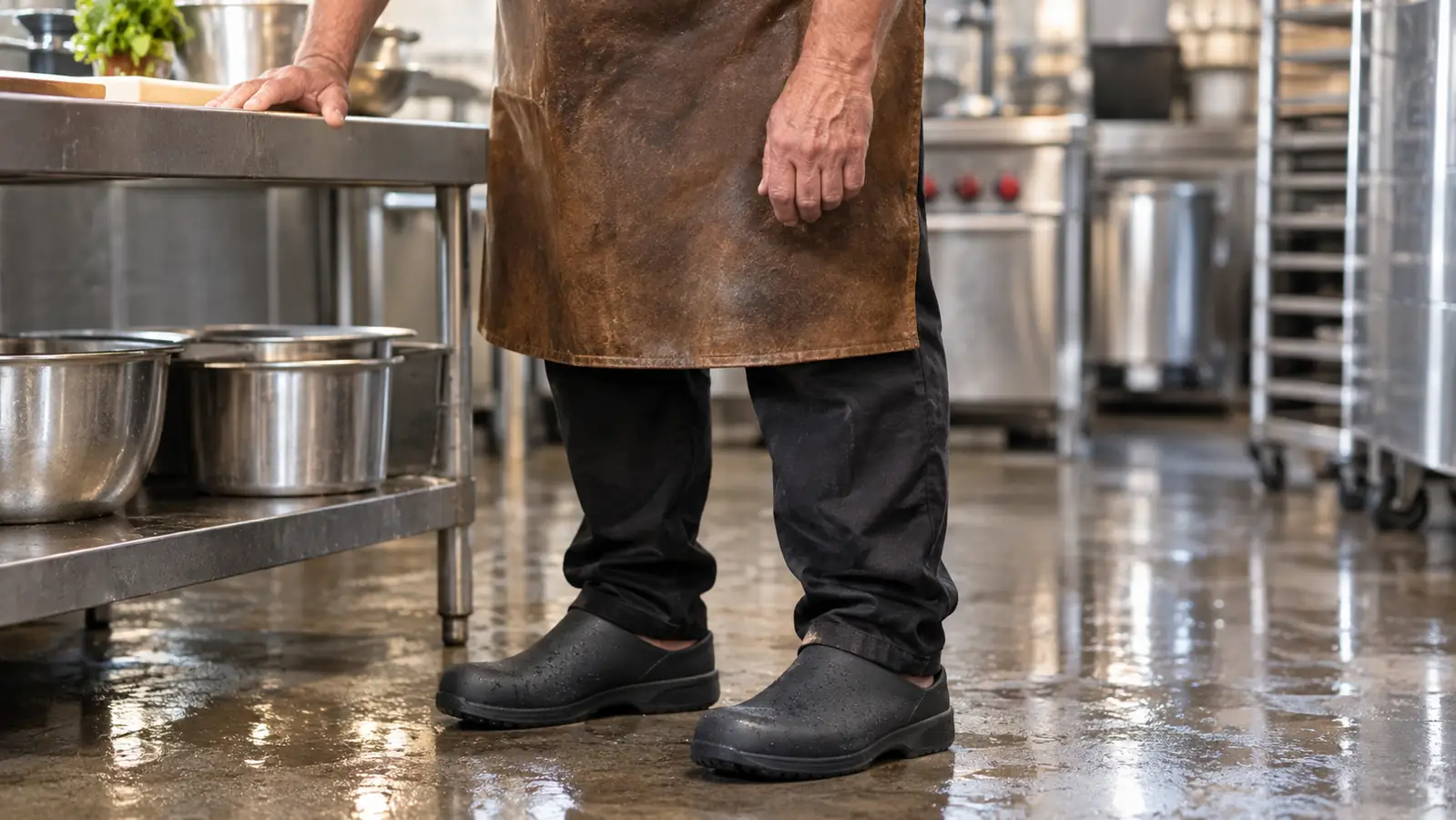
The week the cooler drain backed up was the closest thing to a stress test I've run. I was in the Bistro four shifts in a row instead of alternating, which is not what I usually do. Standing water at the cooler door, a floor fan running all night, and me walking through it with a mop in one hand and a sheet pan in the other. They came out of it fine. The inside stayed dry and the outside wiped clean with a rag. Pulling them on damp the next morning was the only annoyance, and that one is on me for leaving them in the locker instead of on the rack.
By the third week the routine was set. I step in, pull the ankle strap back over my heel, and I'm done. At the end of the shift I kick them off at the door, wipe them with a sanitizer rag if they picked up anything, and leave them to dry. That's the whole maintenance routine. Twenty seconds, twice a day.
What the Bistro Clog Actually Is
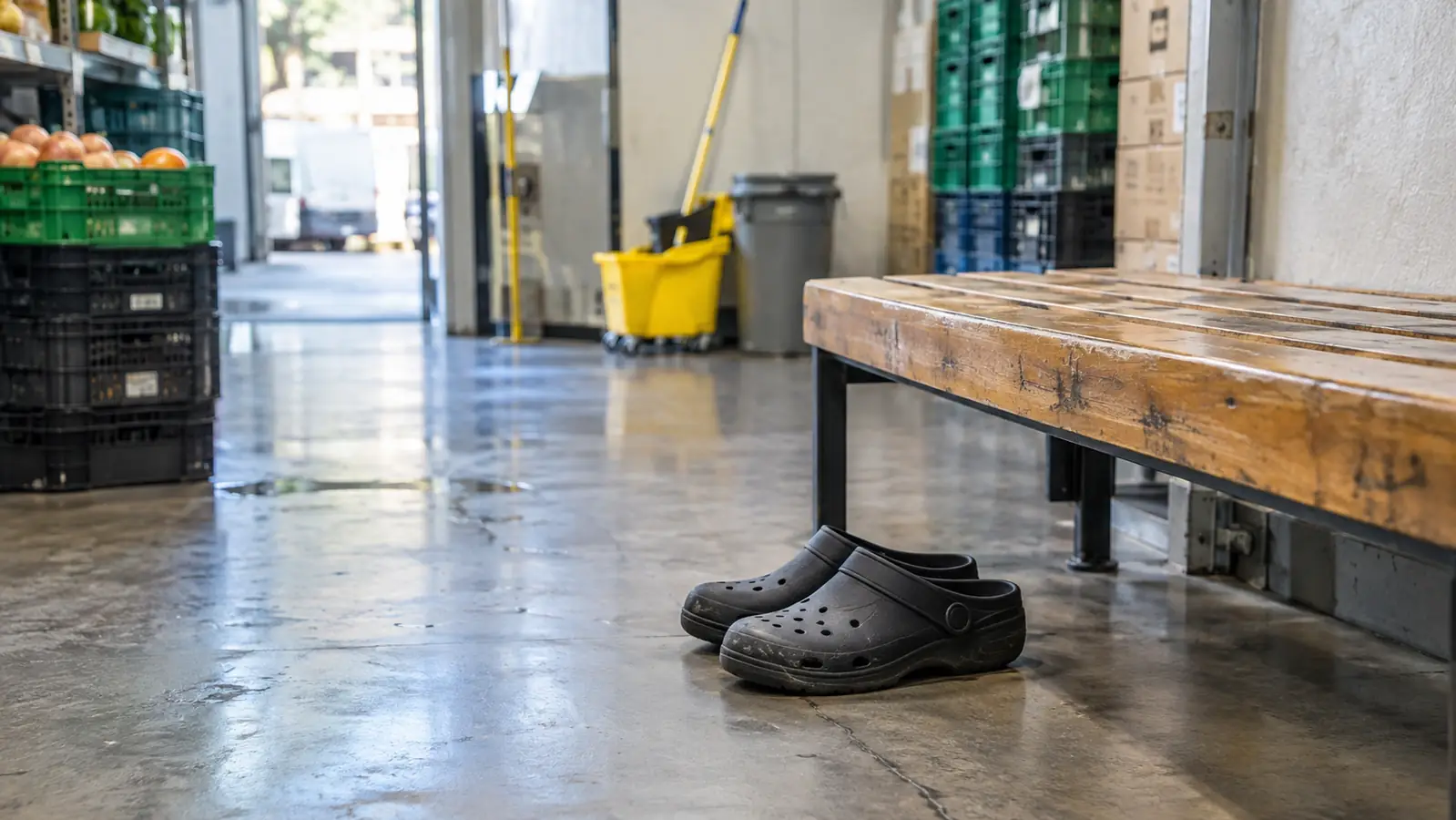
The listing describes a single-piece EVA upper with a rubber sole, closed toe, no heel, pull-on closure, an ankle strap, low arch, and no lining. Sixteen ounces. Waterproof, slip resistant, lightweight. That's a short list and it explains almost everything about how the shoe behaves. One molded upper means no seams for brine or sanitizer to soak into. Unlined means there's nothing inside holding moisture after a shift.
Before this I went through two pairs of canvas work sneakers in about a year and a half. They were comfortable for the first month, then the toe seam on the right shoe started separating from the sole. That seam sits exactly where I brace against the counter edge to push a loaded sheet pan, which means it takes the beating every single shift. A molded upper with nothing stitched there has lasted me considerably longer, and the reason is not complicated: there is nothing attached to come apart. Boring explanation. True one.
The closed toe matters more than people expect in a kitchen. I've had a stock pot land on my foot and I've had a pallet jack roll over a toe. Nothing about the Bistro is a safety toe and I'm not going to pretend it is. But a closed molded toe does more than an open sandal, and it wipes clean in one pass. That's the honest version of that feature.
The ankle strap is the piece people either use or ignore. It swings back for step-in and forward to hold the heel. I wear it forward the entire shift because I'm walking, turning and stepping over things constantly. On a slow morning I'll flip it back and wear them like a slide out to the car. Both are legitimate uses. Only one of them belongs on a wet floor, and I watched a new hire learn that the hard way, clenching her toes all shift to keep a shoe on that she had not strapped.
What Hour Nine Feels Like
Here's the part I can actually speak to, because it's the part I live in. On concrete, hour nine is where a shoe either works or it doesn't. The Bistro keeps my feet from aching the way they did in a flat canvas sneaker, mostly because of that rubber sole and the bit of give in the EVA. It's a firmer ride than a running shoe. It is not a cloud. Anybody who tells you a clog feels like a cloud has not worked a 10-hour shift.
The arch is listed as low, and I want to be straight with you about that. If you have high arches or you've been told you need more support under the middle of your foot, this is not the shoe that gives it to you. There's a modest shape under the footbed and that's all. I had a stretch of heel pain a few years back that my doctor called plantar fasciitis. It settled down with stretching and rest and I'm careful about what I stand in now. I wear the Bistro on the days my feet feel good and I wear something with more under the arch on the days they don't.
The Saturday before Thanksgiving is the worst shift of our year. Ten hours turns into eleven, the line is out past the pie table from open, and I sit down exactly once, to eat half a sandwich standing over a crate. This past year I wore the Bistro for it. At the end I took them off in the break room and my feet were tired the way feet get tired. Not the deep throb in the ball of the foot I used to get in canvas sneakers, the kind that follows you into the car. Tired I can drive home on. Throbbing is what I was trying to get away from.
What I did not expect was how much the low weight changes the last hour. My old work shoes were heavier, and by the end of a shift I was lifting each foot with a little extra effort. Sixteen ounces sounds like a marketing number until you've picked your foot up ten thousand times in a day.
Hour nine on concrete is where a work shoe either earns its place or it doesn't. Most shifts, I get to the car without thinking about my feet at all.
The Wet Floor Problem
Slip resistance is the whole reason a shoe like this exists, and it's the reason I started paying attention to what was on my feet. Grocery floors get wet in ways office floors don't. Water by the dish pit, spilled coffee by the register, a fine mist of flour on the bakery side, sanitizer everywhere. Slip resistant is what the listing claims, and I can tell you that on wet sealed concrete these grip better than the sneakers I used to wear. That is not a promise you will never go down. I still take corners slowly and I still watch for the wet spot nobody put a cone on.
The one time I came close, it wasn't the shoe's fault. Somebody had mopped the aisle by the dairy case and left the cone behind a display, and I took that corner at my usual pace. My foot slid maybe two inches and caught. Two inches is nothing, and it's also a reminder that the floor does not care what you are wearing. But I've taken that same corner a lot further than two inches in other shoes, and that is the honest comparison. Grip is a range. It is not a guarantee.
The sole is rubber, and rubber on a wet floor has been a better bet for me than the foam soles I've worn. It also doesn't pack up with flour the way a softer sole does, which matters on the bakery side. A quick scrape on the mat and it's back to gripping. Small thing, but it compounds across a shift.
Waterproof is the other half of it. I hose down the prep area at close and I've had a wash of water come over the top of a shoe before. With these, the water runs off the outside and the inside stays dry, because the upper is one molded piece with nothing to soak. At the end of a wet close, dry feet isn't a luxury. It's the difference between driving home comfortable and driving home miserable.
Where They Fall Short
The arch support is the big one and I've already said it. If you need real support under the middle of your foot, budget for an insole or pick a different shoe. The footbed that comes with it is modest and it will not become less modest with time. That's a real limitation for a lot of people who work the jobs this shoe is aimed at, and I'd rather say it than have a coworker find out the hard way.
The fit runs roomy. I wear a women's 8.5 with a slightly wide forefoot, and there's space around the front of the foot, which is comfortable with a thick sock and a bit loose without one. If you like a snug shoe, this isn't that. If your foot is narrow, order with that in mind and plan on using the ankle strap to keep the heel where it belongs.
They also look like what they are. Nobody is going to mistake a molded clog for a work boot, and if your job calls for a leather upper, this isn't it. Mine live in a locker. That's fine by me. I care what my feet feel like at hour nine a lot more than what they look like at hour one.
And there's a lifespan question. The EVA will compress and the sole will wear, the same way any shoe wears. I've gotten a good run out of mine and I can feel the difference between the pair I'm in now and a fresh one. This is not a buy-it-once shoe. It's a buy-it-again shoe, which is a different thing and worth knowing going in.
What I Liked
- Light enough that the last hour doesn't feel like dragging your feet
- One molded upper, so nothing soaks in and nothing stains
- Grips well on wet sealed concrete
- Closed toe that wipes clean in one pass
- No laces, no break-in, step in and go
Where It Falls Short
- Low arch, with no real support under the middle of the foot
- Roomy fit that will feel loose on a narrow foot
- Looks like a clog, because it is one
- The EVA compresses over time, so plan on replacing them
Who This Is For
If you stand on a hard, wet floor for a living, this is worth trying. Deli and kitchen work, dish pits, bakery, grocery floor work, hospital food service, warehouse floors, any job where the floor is sealed and the mop comes out at close. It's also a reasonable shoe for nurses and hairstylists, both of which I've handed this recommendation to in the break room. If you want light, wipe-clean, closed toe, and you don't need much under the arch, the Crocs Bistro is the shoe I'd point you toward.
Who Should Skip It
Skip it if you need real arch support and you're not willing to add an insole. Skip it if your foot is narrow and you hate a loose shoe. Skip it if your workplace requires a leather upper or a safety toe, because this is neither. And skip it if you're expecting a soft, cushioned ride at hour ten, because this is a firm, simple clog and it stays that way. Knowing that up front is better than being disappointed on your third shift.
Two pairs on rotation is how I've made mine last
The Bistro is the cheap half of my rotation and the half I reach for on wet mornings. Check the current price and see if it beats what's in your locker.
Amazon Check Today's Price on Amazon →