
If you stand all shift on sealed concrete, the shoe question stops being about style and starts being about damage control. I am Renee Halvorsen, 51, and I run the deli and bakery at a grocery store in Ogden, Utah. I have been on 10-hour shifts for 22 years, usually starting at 5:30 AM, walking the sales floor, the back room, and the walk-in cooler. My feet are a women's 8.5 with a slightly wide forefoot. A few years back I had heel pain in my left foot that my doctor called plantar fasciitis; it settled down with stretching, better shoes, and rest. I do not expect any shoe to fix a foot. I expect it to get me through the shift without making the next one harder. That is the lens I used for this comparison. The Crocs Bistro is the clog I keep coming back to. The Skechers Work Sneakers are the sneaker side of the same conversation.
The short answer is this: if your floor gets wet, greasy, or dusted with flour, the Crocs Bistro is the easier shoe to live with. If your floor is dry and your main complaint is tired feet after hour eight, a cushioned work sneaker like the Skechers Work Sneakers will feel kinder underfoot. I wore the Bistro for a week of my normal shifts and I wore the Skechers sneaker for two full shifts to compare. Neither one is the right answer for every standing job. The rest of this page is the detail behind that split.
| Crocs Bistro | Skechers Work Sneakers | |
|---|---|---|
| Getting them on | Pull-on clog with an ankle strap, no laces to tie | Lace-up, so there is a few seconds of tying each time |
| Fit adjustment | Ankle strap holds the heel, but the clog body is fixed | Laces let you snug the midfoot and loosen the instep |
| Water | Waterproof shell, so spills wipe off instead of soaking in | Most work sneakers are not waterproof; mesh and seams hold damp |
| Cleanup | Wipe with a cloth, no laces or mesh to trap flour and brine | Laces and mesh need more attention at the end of a shift |
| Wet floor grip | Slip resistant rubber sole made for kitchen and hospital floors | Grip varies by model; wet tile is not the main job |
| Underfoot feel | Low arch, no heel, firm sole; not a cushioned ride | Cushioned midsole and a more sneaker-like ride |
| Arch support | Low arch; you add an insole if you need more | More built-in arch shape in most work sneakers |
| Airflow | Unlined EVA, but enclosed; can feel warm by hour eight | Mesh panels move more air |
| Toe coverage | Closed toe | Closed toe |
| Weight | 16 ounces, light for a work clog | Varies by model; many are heavier, some are close |
| Best for | Wet, messy floors and shifts with constant on and off | Dry floors and long stretches where cushioning matters most |
Where Crocs Bistro Wins
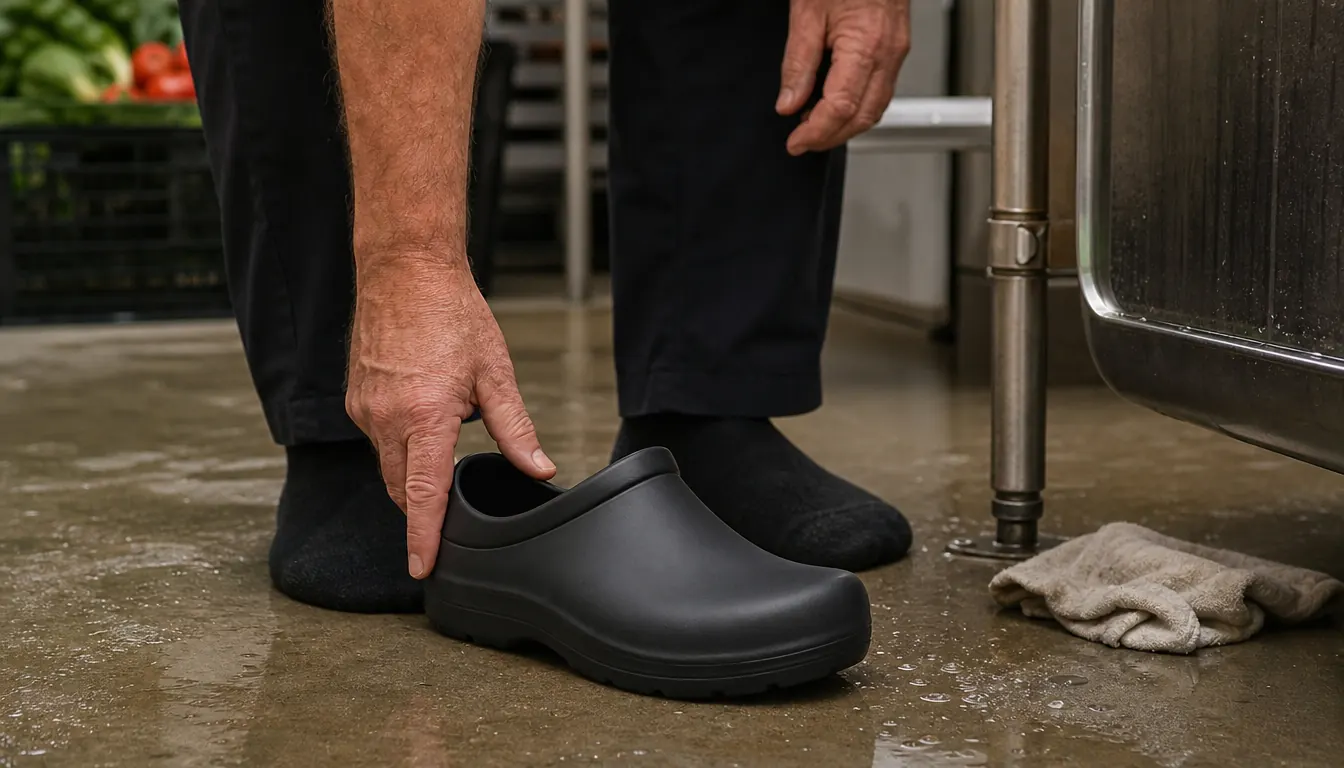
The Bistro wins the mess. It is waterproof, and that word is doing real work in a grocery store. I have had a mop bucket tip, a sanitizer pail slosh, and a bag of frozen berries leak on my shoes in the same week. The Bistro wipes off with a paper towel and a squirt of cleaner. There are no laces to soak, no mesh to hold the smell, and no seams for flour to pack into. The enclosed toe is the other part I notice. I am not worried about a dropped can or a cart wheel catching my toes the way I am in a soft sneaker. The slip resistant outsole is the reason I keep a pair by the time clock. On wet tile near the dish pit, I can feel the rubber sole grip instead of skate. That is the floor I actually work on.
The Bistro also wins on speed. It is a pull-on clog with an ankle strap, so I can step into it at 5:25 AM without tying anything. When I work the walk-in cooler and then come back to the warm deli, I am not dragging a wet lace around. At 16 ounces, it is light enough that I do not feel like I am lifting a boot with every step. The low arch and no heel took me a few days to get used to again after wearing a sneaker, but that is the trade for a shoe that does not fight me at the door. The EVA outer is firm, not soft. If you want a pillow, this is not it. If you want a shoe you can hose off and keep moving, this is the one I reach for.
Where Skechers Work Sneakers Wins
The Skechers work sneaker wins the cushioning. The pair I wore has a softer midsole and a more shaped arch than the Bistro, and by the end of a 10-hour shift my feet felt less pounded. I noticed it most on the long walk from the bakery to the front end and back, the kind of back-and-forth that adds up to miles on sealed concrete. The sneaker also breathes better. The Bistro is unlined EVA, but it is still an enclosed shoe, and by hour eight my feet can feel warm. The sneaker moves more air, especially through the mesh panels. If you run hot and your floor is dry, that matters.
The sneaker also wins on fit adjustment. Laces let me snug the midfoot and loosen the instep when my feet swell later in the day. The Bistro's ankle strap holds the heel, but the body of the clog is fixed. If you have a high instep or a very narrow heel, the sneaker is easier to dial in. The sneaker also has a more traditional heel and a shaped arch, which some people want for standing all day. I am not going to pretend that a low arch clog is the right call for every foot. If your feet ache from lack of support, the Skechers Work Sneakers are the more familiar answer. The trade is that you give up the waterproof shell and the wipe-clean finish.
If the floor is wet, the Crocs Bistro is the shoe that keeps up.
Waterproof, slip resistant, and easy to wipe down at the end of a shift. See the current listing on Amazon.
Amazon See the Crocs Bistro on Amazon →How I Compared Them
I did not run a lab test. I ran my normal week. I wore the Crocs Bistro for five shifts, 10 hours each, starting at 5:30 AM. I wore the Skechers Work Sneakers for two shifts, both on dry days, so I could feel the difference in cushioning without a wet floor skewing the result. I kept the same socks, the same route through the store, and the same habit of alternating shoes so each pair could dry out. I have two pairs of work shoes in rotation and I do not wear the same pair two days in a row. That habit is older than this comparison. It is also the reason I can tell you how a shoe feels on day one versus day four.
The first thing I check is the trip from the time clock to the department. It is maybe 40 yards on sealed concrete, but it tells me how a shoe lands. The Bistro lands firm and a little flat. The sneaker lands softer and rolls forward more. The second thing I check is the walk-in cooler. It is wet in there, and the floor is cold. The Bistro does not care. The sneaker gets damp at the toe and stays damp. The third thing I check is the end of the shift. I sit on the bench in the break room, take off one shoe, and see how my foot feels. The Bistro leaves my foot tired but not beat up. The sneaker leaves my foot less pounded but warmer. That is the honest split.
The Bistro wins the wet floor and the cleanup. The sneaker wins the cushioning and the airflow. I did not find one shoe that wins both.
The Wet Floor and Cleanup Test
I spilled a quart of pickle brine on the floor by the walk-in on a Tuesday. It happens. I was wearing the Crocs Bistro. I wiped the shoe with a rag, rinsed the sole, and went back to the line. The waterproof shell did not soak through. The rubber sole did not slip when I stepped back onto the wet tile. That is the whole reason I keep a clog in the rotation. A work sneaker with mesh and laces would have been wet for the rest of the shift. I would have felt it every time I stepped into the cooler.
Cleanup at the end of the day is the other half of that. The Bistro gets wiped with a sanitizer wipe and set on the rack. The sneaker needs the laces loosened, the tongue pulled up, and the inside packed with newspaper if it got damp. I am not saying the sneaker is fragile. I am saying it asks more of me at 4:00 PM when I want to go home. If you have ever scrubbed flour out of a shoelace, you know the difference.
Break-In and Daily Wear
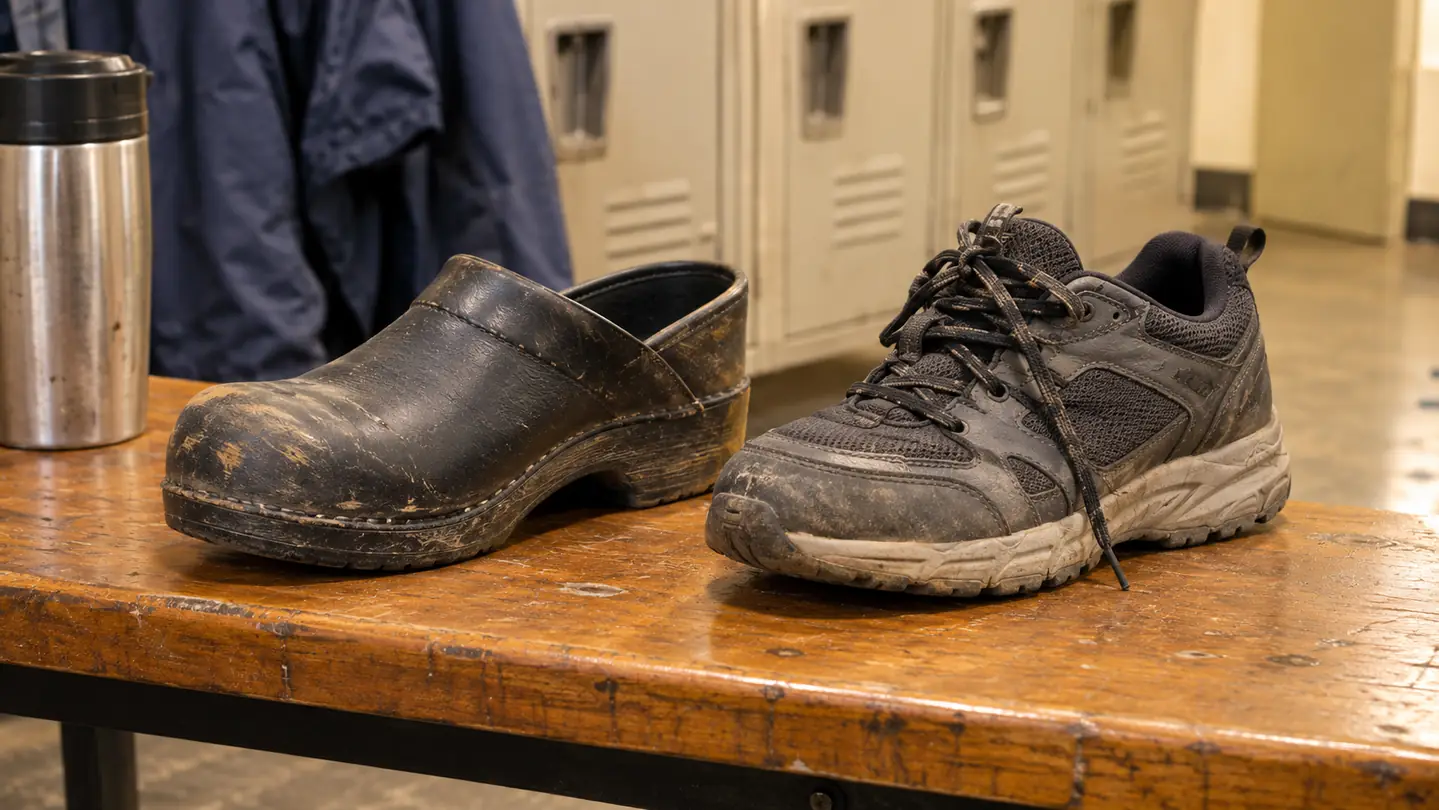
The Bistro did not need a break-in. The first shift felt like the fifth. That is the upside of a clog with an EVA upper. There is no tongue to fold, no collar to rub, no lace to retie. The ankle strap took me one shift to get used to because I was not used to feeling it across the back of my heel. By day two I stopped noticing it. The low arch was more of an adjustment. I came from a sneaker with a shaped footbed, and the flat inside of the clog felt like standing on a board for the first hour. It did not hurt. It just felt different. By the end of the week I was used to it.
The Skechers sneaker needed a short break-in at the collar. The first shift left a red mark just above my heel. The second shift was better after I loosened the top lace. That is normal for a lace-up work sneaker. The cushioning was there from the start. The shoe felt more like a running shoe than a clog, which is either the point or the problem, depending on what you want. I would not want to break in a new pair on a 10-hour shift with no backup. I would wear them for a short shift first. With the Bistro, I would not bother. That is a real difference in daily wear.
Fit Notes for Wide Forefeet
My forefoot is slightly wide, and the Bistro is friendly to that. The clog body has room across the ball of my foot. The ankle strap keeps the heel from sliding off when I walk fast. I take my normal women's 8.5. If you are between sizes, I would not size up just because it is a clog. The enclosed toe gives me a little bump room without pinching. The low arch is the part to watch. If you need more arch support, the Bistro does not have it. You can add an insole if the shoe has room, but that changes the fit. I tried a thin insole for two shifts and went back to the plain shoe. The extra layer made the top of my foot feel crowded.
The Skechers Work Sneakers fit more like a sneaker. I lace them snug across the instep and leave a little room at the top. That is easier to adjust than a clog, especially if one foot swells more than the other by the end of the day. The sneaker also holds the heel more securely without a strap. If you have a narrow heel and a wide forefoot, that is a useful difference. The Bistro can feel loose in the heel if you do not use the strap. Use the strap. It is there for a reason.
Who Should Buy Which
Buy the Crocs Bistro if you work in a kitchen, a deli, a bakery, a hospital, or any floor that gets wet and messy. Buy it if you want a shoe you can step into, wipe down, and forget about. Buy it if you have a low arch or you are fine adding your own insole. Buy it if you are on and off your feet, in and out of a cooler, and you do not want to deal with laces. I would not buy it if you need a soft ride or a lot of built-in arch support. I would not buy it for a dry concrete floor where your main complaint is impact. That is not what it is for.
Buy the Skechers Work Sneakers if your floor is dry and your feet ache from the concrete by hour six. Buy them if you want laces to adjust the fit, more cushioning, and more airflow. Buy them if you have a high instep or a narrow heel and a clog feels loose. I would not buy them for a wet dish pit, a mop bucket zone, or a floor where flour and brine land on your shoes. The sneaker is the better shoe for dry, long, straight standing. The clog is the better shoe for wet, messy, up-and-down work. That is the line I would draw.
The clog I keep by the time clock.
If your shift looks like mine, wet floors and all, start with the Crocs Bistro. See the current listing on Amazon.
Amazon See the Crocs Bistro on Amazon →