
Every few months somebody in my store asks me what shoes to buy for work, and the answer has been the same for years now. It depends on whether you need cushioning or structure. Two shoes come up in that conversation more than any other. The Skechers D'Lux Walker is the pair I wear on the days I am moving all shift. The Brooks Addiction Walker is the pair a coworker in my store has worn five days a week for three years. Both are sold as work shoes for people who stand all day. They are not interchangeable.
Short answer first, because that is usually what people want. If you stand in one spot for ten hours on sealed concrete and you have a history of heel pain, the Brooks is the more supportive shoe and I would not talk you out of it. If you walk the floor all shift, want something light, and want to be able to afford two pairs so you can rotate them, the Skechers D'Lux Walker is the better buy for most people who ask me. Everything after this is the reasoning, so you can match it to your own feet.
| Skechers D'Lux Walker | Brooks Addiction Walker | |
|---|---|---|
| Cost tier | Low enough that two pairs and a rotation is realistic | High enough that most people I know own one pair and wear it daily |
| Getting them on at 5:20 AM | Pull-on, no laces, foot goes in and you are done | Laces to tie and adjust every single time |
| Underfoot feel on the first step | Memory foam insole, soft and springy right away | Firm and dense, very little give |
| Support at hour nine | Soft enough that I feel the concrete through it late in the shift | Still holding my foot in place at hour ten |
| Weight | Listed at 2 pounds and feels light on the foot | Noticeably heavier in the hand |
| Break-in | None that I noticed | About a week of shorter wears before it stops pressing on the top of the foot |
| Spills and the walk-in cooler | Upper is marked water resistant and wipes clean with a rag | Leather sheds a splash, but it holds water once it soaks through |
| Slip resistance | Marked slip resistant on the listing, no trouble on wet tile | Work outsole, no slips from that pair in three years |
| Width and fit | Standard width, roomy across a slightly wide forefoot | Sold in a range of widths, which some feet genuinely need |
| How long before they look beaten | Upper creases and the insole sets | Leather keeps its shape for years |
| Best for | Constant walking, split shifts, people who want to rotate two pairs | Ten hours planted on concrete with a foot history |
What the Skechers D'Lux Walker Actually Is
The listing is unusually specific for a work shoe, so start there. It is a pull-on with no laces, a closed toe, and no heel to speak of. The insole is memory foam. The upper is water resistant. The listing marks it slip resistant and puts the weight at 2 pounds. That is the whole hardware list, and it tells you most of what you need to know about who it suits and who it does not.
No laces is the part I underrated for years. At 5:20 in the morning I am not bending over to tie anything, and by the end of a shift my hands are tired from lifting trays and scrubbing. A pull-on goes on standing up, in the dark, in a cold car, without a fight. If you have ever driven to work in one pair of shoes and changed into another in the parking lot, you know what that is worth.
The memory foam insole is soft on the first step and stays soft for a few months. That is the honest version. Somewhere around month four or five, depending on how many hours you put in, the foam compresses and you are standing on the base of the shoe rather than on the padding. That is the point where people either buy a new pair or put an aftermarket insole in and keep going. Neither choice is wrong.
The upper wipes clean, which matters in a deli. Flour, sanitizer water, a dropped container of dressing, all of it comes off with a rag at the end of the shift. Water resistant is not waterproof, and the listing is careful with that word, so do not read it as a rubber boot. A splash by the sink or a wet floor after mopping is fine. Standing in a puddle in the walk-in cooler is not.
What the Brooks Addiction Walker Brings
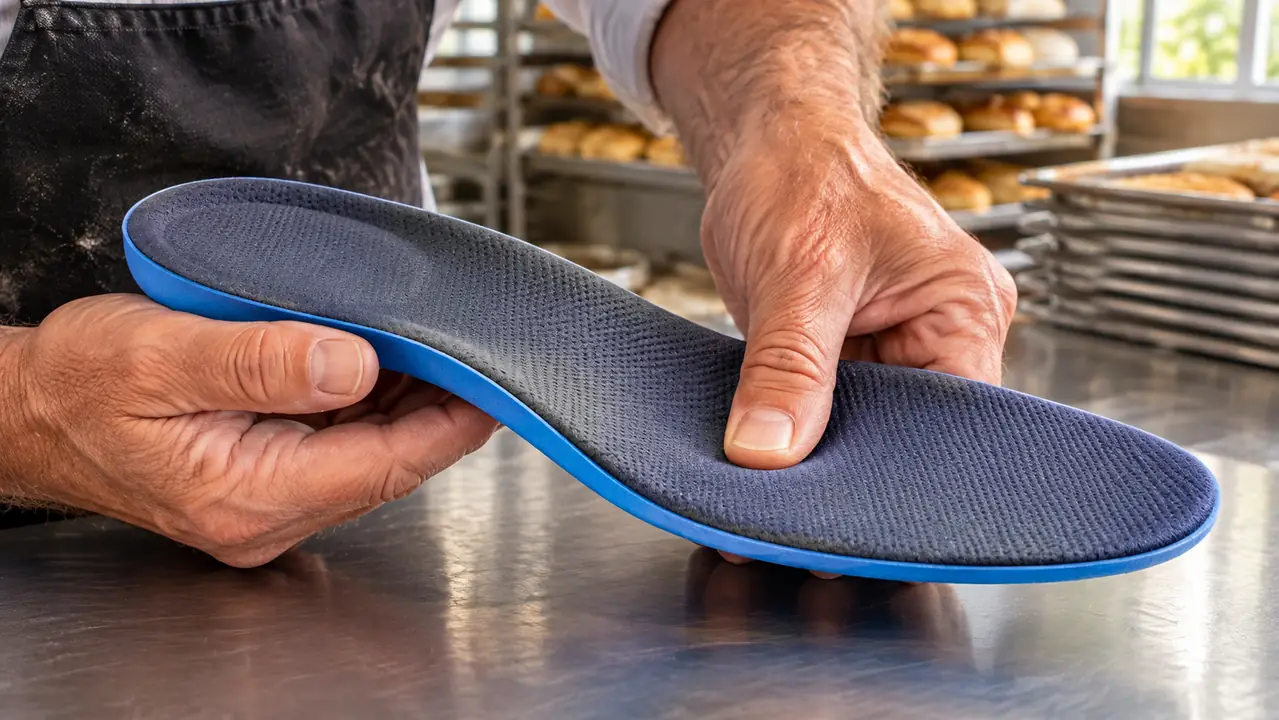
The Addiction Walker is a different animal. It is built as a motion control shoe, which is a polite way of saying it does not let your foot roll around inside it. The midsole is firm and dense. It has a leather upper that holds its shape, laces, and a work outsole. It weighs more than the Skechers and you can feel that in your hand before you ever put it on.
I have watched the same pair get worn five days a week for three years by a man who is on concrete from six in the morning until four in the afternoon. He has replaced the laces twice. The shoe itself still has structure. That is what people are paying for, and it is the thing the softer shoe cannot match. Not softness. The fact that it is still doing its job at the end of a long shift and at the end of a long year.
The trade for that is break-in. A firm shoe with a leather upper presses on the top of your foot and around the heel for the first week or so. My coworker wore his around the house and on short errands before he took them to a full shift, and he tells everybody to do the same. The Skechers has no such ritual. You put it on and go to work.
The other thing the Brooks does better is width. It is sold in a range of widths, which is why some people simply cannot switch away from it once they find their size. If your forefoot is wide enough that a standard width pinches, that range is not a luxury. It is the whole decision.
Same pair, three years, five days a week on concrete, and the structure is still there. The Skechers is softer. It does not do that.
What a Ten-Hour Shift Does to a Shoe
People who have never done it think standing is the easy version of working. It is not. Ten hours on sealed concrete does two things to a shoe. It compresses the padding under the heel and the ball of the foot, and it slowly teaches the upper to lean the way your foot leans. By the end of a week you can see which foot you favor.
That is why rotation works. Two pairs, alternating days, gives each one about forty hours to dry out and spring back. A shoe that never dries out keeps the shape of yesterday's shift, and the foam never recovers. I have done this with every pair I have owned for the last fifteen years, cheap or expensive, and it is the single thing that has added the most life to a work shoe.
It is also why I do not trust a review written after two weeks. Any shoe feels fine for two weeks. The question is what it feels like in month six, when the insole has taken a set and the upper has stopped being new. That is when the difference between a soft shoe and a firm one shows up, and it is why I compare these two the way I do.
Where Skechers Wins
Cost tier is the obvious one and I will not pretend otherwise. The Skechers sits in a bracket where two pairs and a rotation costs roughly what one pair of the Brooks does. That matters, because the rotation is not a small thing. It is the difference between a shoe that lasts a season and a shoe that lasts a year.
Weight and ease are next. Two pounds on the listing, and it feels lighter than that on your foot. The pull-on closure means no crouching at the door and no laces coming untied behind a counter. For a job where you are in and out of a cooler, stepping up on a ladder for the top shelf, and walking the floor rather than standing at one station, that lightness counts for more than a firm platform does. The Brooks makes its presence known. The Skechers disappears.
And the fit suits a slightly wide forefoot without going to a wide size. Mine is a women's 8.5 and a touch wide across the ball of the foot, and the standard width in the D'Lux Walker is roomy enough that I am not thinking about it by nine in the morning. If your foot is genuinely wide, though, read the next section, because that is not a problem I would try to solve with a roomy standard width.
Where Brooks Wins
Support, plainly. That firm midsole does something memory foam cannot. At hour eight, after the concrete has had all day to work on you, the Brooks is still holding your foot in the position it started in. The softer shoe has gone flat and you feel the floor through it. If you have a history of heel pain, or a foot that rolls inward, that difference is the whole ballgame. It is why the shoe costs more and why it is worth it to the people it suits.
Durability of the structure. Leather creases, but it does not collapse. Three years on the same pair, as I said. The Skechers upper holds up fine, but the insole is a wear item with a shorter clock on it, and if you are buying aftermarket insoles every six months you are quietly spending the difference anyway.
Width range, again. If standard width does not fit you, this is not a preference. I would rather send somebody to a store to try the Brooks in their actual width than have them order a shoe that pinches and then blame me for it. That is the honest end of this comparison.
Two pounds, no laces, on your feet in the dark at 5:20
The D'Lux Walker is the pair I keep in rotation for the days I am walking the floor instead of standing at the slicer. Slip resistant, water resistant upper that wipes clean, memory foam insole, and a pull-on that goes on standing up. If cushioning is what your feet are asking for, start here.
Amazon Check today's price on Amazon →Who Should Buy Which
Buy the Skechers D'Lux Walker if you walk more than you stand. If you are in and out of a cooler, up and down a ladder, moving between a counter and a back room, and if the idea of lacing anything at five in the morning makes you tired, it is the right shoe. It is also the right first work shoe, because it breaks in immediately and it does not punish you while you figure out what your feet actually want.
Buy the Brooks Addiction Walker if you stand in one place for most of the shift, if you need a real width rather than a roomy standard one, or if you have had heel pain or a foot that rolls and you already know you want structure under it. It asks for a week of break-in and it costs more. It also outlasts the softer shoe by a wide margin, and for some people that is the only math that matters.
The third option is what I actually do, and I would be doing you a disservice not to say it. Buy the Skechers, buy two pairs, alternate them, and replace the insoles when the foam sets. If your feet start complaining at hour eight, an aftermarket insole buys you months. That is the cheapest way through a long year on concrete, and it is less a compromise than a plan.
The pair I would hand a new hire on their first day
Light, slip resistant, water resistant, no laces to tie, and a memory foam insole that is soft from the first step. If you need the firm support instead, everything I said about the Brooks stands and I would not argue with you. But for most people starting a standing job, this is where I would start.
Amazon See the current price on Amazon →