
Here is the information I actually want before I spend my own money on a work shoe: what does it feel like at hour eight, and what does it look like at month six. Not the unboxing. Not the four laps around the living room carpet while a teenager in a store polo nods at me. Hour eight and month six.
I manage the deli and bakery at a grocery store in Ogden, Utah. Twenty-two years of it. Ten-hour shifts, most of them starting at 5:30 in the morning, and the surface under me never changes. Sealed concrete from the front of the store to the back room to the walk-in cooler and back again. I have bought a lot of shoes that felt like pillows in the aisle and felt like bricks by Thursday. I am 51, my feet are a women's 8.5 with a slightly wide forefoot, and I have opinions about this.
So when I tell you I have been wearing the Brooks Addiction Walker 2 for the better part of a season, five days a week, on the same concrete I have complained about for two decades, that is the frame for everything below. This is not going to be the review that tells you it changed my life. It is the review that tells you where it held up, where it did not, and the one fit detail that decides whether it works for you at all.
The Quick Verdict
A genuinely supportive walking shoe for long shifts on hard floors, with a firm ride some people will love and some will resent. Buy it for the stability, not for softness.
Amazon Check Today's Price →If you want support over softness, this is the one to look at
The Brooks Addiction Walker 2 is built for people who stand for a living, not people who jog. Comes in a wide width, which is why most of us end up here in the first place. Check the size run before you commit.
Amazon Check Today's Price on Amazon →What the Brooks Addiction Walker 2 Actually Is
The Addiction Walker line has been around long enough that coworkers who have never bought a walking shoe on purpose still recognize the name. The 2 is the current version, and it is unapologetically an occupational shoe. It is a lace-up walking shoe with a closed toe and no heel, cushioned through the midsole with BioMoGo DNA, and the listing names cushioning and slip resistance as the two features that matter. It is not water resistant, which is a bigger deal in my line of work than any of the marketing language suggests, and I will get to that.
What it is not: it is not a running shoe, it is not a trail shoe, and it is not pretending to be either. Brooks files the sport type as hiking and the occasion as athletic, which is retail category noise more than anything a real person would say out loud. On the shelf and on the floor it reads as a support-first walking shoe for somebody who spends the day upright.
What Nobody Tells You Before You Buy
The first thing nobody mentions is how firm it is. This is a stability shoe, and stability means a platform that does not fold or roll under you when you shift your weight. That is precisely why I can stand on concrete for ten hours in it. It is also why a chunk of the four-star reviews read like three-star reviews with a polite ending. People expect a walking shoe to feel soft and sinking, and this one feels planted instead. If you want to sink, you will know within the first mile that you bought the wrong thing.
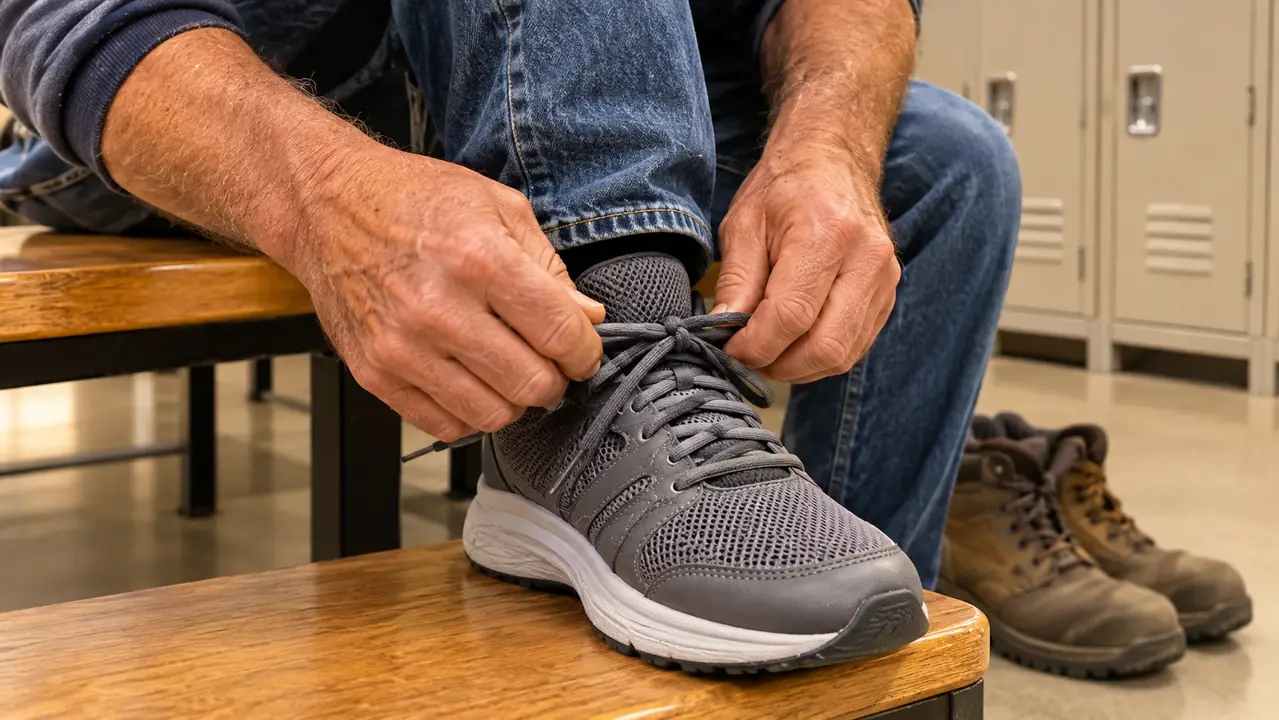
The second thing is the break-in. Not a long one, but not zero either. For the first three shifts, the left shoe pressed slightly across the top of my forefoot right where the lacing begins. Nothing dramatic and no blister, just a spot I was aware of by the end of the day. By the end of week one it was gone and I stopped thinking about it. A coworker who bought the same shoe said she had the same three days and then forgot it, so I do not think I imagined it.
The third thing matters most and almost never makes it into a review. This shoe is not water resistant, and the grocery business is wet. The walk-in cooler floor is damp most of the morning. The dish area is wet. In February the entry mat is soaking from the front door. The Addiction Walker 2 will take on water, and once it does, the cushioning under your foot feels different for the rest of the shift while it dries. Nobody at the shoe store brings this up. I am bringing it up because I stood in a puddle in week two and learned it the hard way.
The Addiction Walker 2 is not soft. It is planted. On concrete for ten hours, planted is the thing I actually need.
That is the honest trade at the center of this shoe. You are not buying comfort in the pillow sense. You are buying a base that still holds its shape at hour nine, and for my money that is the better deal on a hard floor.
What Six Weeks of Real Shifts Felt Like
My habit is two pairs, alternating days, so each one gets a full day to dry out. I picked that up years ago and it roughly doubles the life of any work shoe. The Brooks went into that rotation on a Monday. First shift: stiff, stable, no surprises. Second shift two days later: the same. There is no dramatic first-week arc here. It starts out planted and it stays planted, which is a boring thing to write and a good thing to own.
The first genuinely hard test came on the second Saturday, which is truck day. Bakery delivery lands at 6:15, the pallets come off the dock, and I am up and down the back room hauling flour and boxes for two hours before the deli even opens. On the old shoes that morning used to cost me by noon. I finished that Saturday, drove home, walked to the mailbox, and did not think about my feet once. That is the whole review in one morning, honestly.
The change I did notice arrived around week three, and it was not in my feet. It was in my knees. On the last pair of inexpensive walking shoes I owned, my knees were complaining by the end of a Friday. On the Brooks, that complaint faded back into background noise. I am not going to tell you the shoe did something medical, because it did not and I am not qualified to say it did. What I can tell you is that a firmer platform under me meant I stopped bracing with my legs by mid-afternoon, and my knees noticed the difference.
Grip held up too. The listing calls the tread non-slip and I would call it predictable, which is the word I actually care about. On dry concrete and on a slightly damp cooler floor it does what I expect it to do. On genuinely wet tile near the dish sink it is no better than any other shoe without a real wet-grip compound, and I still take that corner slowly. Nothing about it made me nervous. Nothing about it made me cocky either, which is the correct outcome.
The Parts That Genuinely Bother Me
The water issue is the big one and I have already covered it. The second is the look. This is a substantial shoe. It is wide, it is built up, and it does not disappear under a pair of work pants. If you wear slacks on a hospital floor or you are on your feet in a nicer retail setting, this reads as a sneaker and nobody will mistake it for anything else. I do not care. Several of my coworkers do, and they have told me so.
The third is the price point. I am not going to quote a number because it moves around, but this is not a cheap shoe and it does not pretend to be one. What I will say is that the math works out over time if you alternate pairs and get a full year out of each. If you are hard on shoes, or you only own one pair and wear it six days a week, the math is a lot less friendly. I keep a log on the inside of the closet door, which sounds fussy and takes ten seconds a week. The last pair I retired went fourteen months of alternating wear before the midsole stopped coming back overnight. A woman on the front end who wore hers five days straight retired the same model in seven months. Same shoe, twice the life, and the only difference was whether it got a day off.
Fourth, and this is small: the laces run long. I double knot. Fine.
Mistakes I Made With It
I made three, and all three are worth passing along. The first was wearing it two days in a row in the first week because the other pair was still damp. By the end of that second shift the shoe felt heavier and warmer and the cushioning had flattened out in a way it does not when the shoe starts the day dry. That is not a flaw in the shoe. That is a flaw in my laundry schedule, and it confirmed why the rotation habit exists.
The second mistake was thin socks. With a thin sock the instep pressure in those first three shifts was noticeably worse, and once I switched to a cushioned crew sock it mostly went away. The shoe has volume in it, so a thin sock leaves your foot sliding a little inside. The third mistake was expecting it to handle a wet February entryway the way a boot would. It is not a boot. It is not water resistant. I now keep a second pair in the back room during the wet months and swap at lunch, which is the unglamorous solution that actually works.
The sock fix is the cheapest thing on this list and I wish I had done it in week one. I switched to a cushioned crew sock on a Tuesday in the third week and by Thursday the instep pressure was gone. That was three shifts of a problem that an ordinary cushioned sock would have solved from the start. If you take one thing from this section, take that one: the shoe has volume, so fill it.

The Fit Detail That Trips People Up
Here is what sends more people back to the return counter than anything else about this shoe. The Addiction Walker 2 runs roomy, and the standard width is a real standard width with volume in it. Women with a narrow or average forefoot often size down half a size and are perfectly happy. Women with a wide forefoot, which is me, order the wide and get a shoe that fits from the first shift with no drama. If you order your usual size and you have a slim foot, you will feel like you are wearing someone else's shoe.
So figure out which of those two people you are before you order, because the gap between the standard width and the wide is not subtle. My feet are a women's 8.5 with a slightly wide forefoot, and the 8.5 in the wide is correct for me. A coworker with a narrow foot who wears the same 8.5 in everything tried mine on and said immediately that she would have to go down half a size. That is a real data point from a real break room, not a guess from a spec sheet. One more thing about sizing: measure at the end of a shift, not first thing in the morning. My feet are measurably longer at four in the afternoon than at six in the morning, and every woman I have asked in a break room says the same. I have watched two new hires order the wrong width because they tried a pair on at nine in the morning after a day off.
What I Liked
- Firm, stable platform that still holds its shape at hour nine of a ten-hour shift
- Roomy forefoot in the wide width, comfortable from the first full day
- Predictable grip on dry concrete and on lightly damp cooler floors
- Comes in a wide width, which is why most people end up looking at Brooks
- Wears well when alternated with a second pair so each one dries out
Where It Falls Short
- Not water resistant, and wet floors are everywhere in grocery and food service work
- The firm ride reads as harsh if you want a soft, sinking shoe
- Runs roomy, so narrow feet usually need to size down half a size
- Visibly a sneaker, not something that passes as a dress shoe
- Costs real money and really wants a rotation to justify it
Who This Shoe Is For
If you stand on hard floors for a living and you want a platform that does not collapse by two in the afternoon, this is the shoe. Nurses, grocery and retail staff, warehouse pickers, kitchen leads, hairstylists, anyone whose shift is measured in hours upright rather than miles covered. It also suits people who have been told they need more support and do not want to jump all the way to something clinical. The wide width is the reason a lot of people land on Brooks in the first place, and it is the reason I would point a new hire here before I pointed her anywhere else.
Who Should Skip It
Skip it if you want soft. Skip it if your day involves actual standing water, because it is not water resistant and it will soak through on you. Skip it if you need something that passes as a dress shoe on a hospital floor or in a bank branch. And skip it if you are only going to own one pair and wear it six days a week, because this shoe rewards rotation and it will not last the way you want if it never gets a day to dry.
The Honest Bottom Line
The Brooks Addiction Walker 2 is a tool, and a good one for a specific job: long shifts, hard floors, feet that need a stable base underneath them. It is not soft, it is not waterproof, and it will not flatter your work pants. What it will do is still feel like a shoe at hour nine instead of a wet sponge with laces. After twenty-two years on sealed concrete, that is the trade I have learned to make, and I would make it again.
If you already know you want support over softness, this is an easy call. If what you actually want is a cloud, keep looking, and be honest with yourself about that before you order, because the return shipping is on you.
The shoe I would buy again for a concrete floor
A roomy wide fit, a firm platform that survives a ten-hour shift, and a name that has been doing this job for a long time. Check the size run and the wide width before you order.
Amazon Check Today's Price on Amazon →