
The Crocs Bistro clog has around 75,000 reviews and almost every one of them glows. That is a difficult thing to read when your own first week in them was a series of small negotiations. I manage the deli and bakery at a grocery store in Ogden, Utah. That is twenty-two years of ten-hour shifts on sealed concrete, and I have bought a lot of shoes that were supposed to solve it. So this is the version of the Bistro that the five-star reviews leave out, including the two things that nearly had me sending my first pair back.
Short answer first, because you probably scrolled past the reviews looking for it. The Bistro is the closest thing I have found to a work shoe that gets through a full shift on hard floor without asking anything of me. It is also a shoe with real limits, and some of those limits will matter to you more than they matter to me. I wear a women's 8.5 with a slightly wide forefoot and I am on the floor five days a week. Everything below comes from that, not from a fitting room.
The Quick Verdict
Light, genuinely grippy on wet tile, and it survives a season of ten-hour shifts. Stiff for two weeks, and thin under the arch if you need support.
Amazon Check Today's Price →The work shoe I now buy in pairs instead of replacing every few months
One molded piece, no seams for flour and grease to hide in, and a rubber sole that holds on a wet floor. Check the size chart before you order, because these come in whole sizes only.
Amazon Check Today's Price on Amazon →How I've Used Them
I started on a Monday, which is a bad day to test anything. Truck day, two pallets of frozen, and a cooler that runs around 38 degrees. Ten hours later I drove home with the shoes still on, because my feet did not feel like they needed rescuing. I could not say that about the safety sneakers I wore before. The first thing I noticed was not cushioning. It was that my heels were not throbbing at the end of the day, which is a lower bar than it sounds and one that most work shoes fail.
Before the Bistro I went through two pairs of safety sneakers in about eight months. Both had a thick sole and both were tolerable for the first month. What killed them was the seam along the outside of my little toe, which split open from bending, and a heel that packed down until it felt like standing on a folded towel. Before that I tried a pair of walking shoes with a gel heel cup. The gel flattened in about six weeks and the mesh uppers soaked up mop water. The Crocs Bistro was the first pair where I did not have a complaint ready by Friday.
Ten-hour shifts, five days a week, usually a 5:30 start. I walk the sales floor, the back room and the walk-in cooler, and I stand at a bench rolling dough for an hour or two at a time. I keep two pairs of work shoes and alternate days so each pair dries out, a habit I picked up from a coworker who wrecked a good pair by wearing the same ones five days running. The Bistro suits that rotation because it is one molded piece of EVA with a rubber sole, and there is no stitching along the sides of the foot for water to sit in.
I have worn this pair since late winter. Apart from a scuff on the outside of the left shoe, they look like the day they came out of the box. No splitting where the toe bends. Nothing peeling at the sole line. That is more than I expected from a molded shoe on concrete, and it is the reason I stopped reading reviews that said the same thing and just bought a second pair to rotate.
What Nobody Tells You: The First Two Weeks
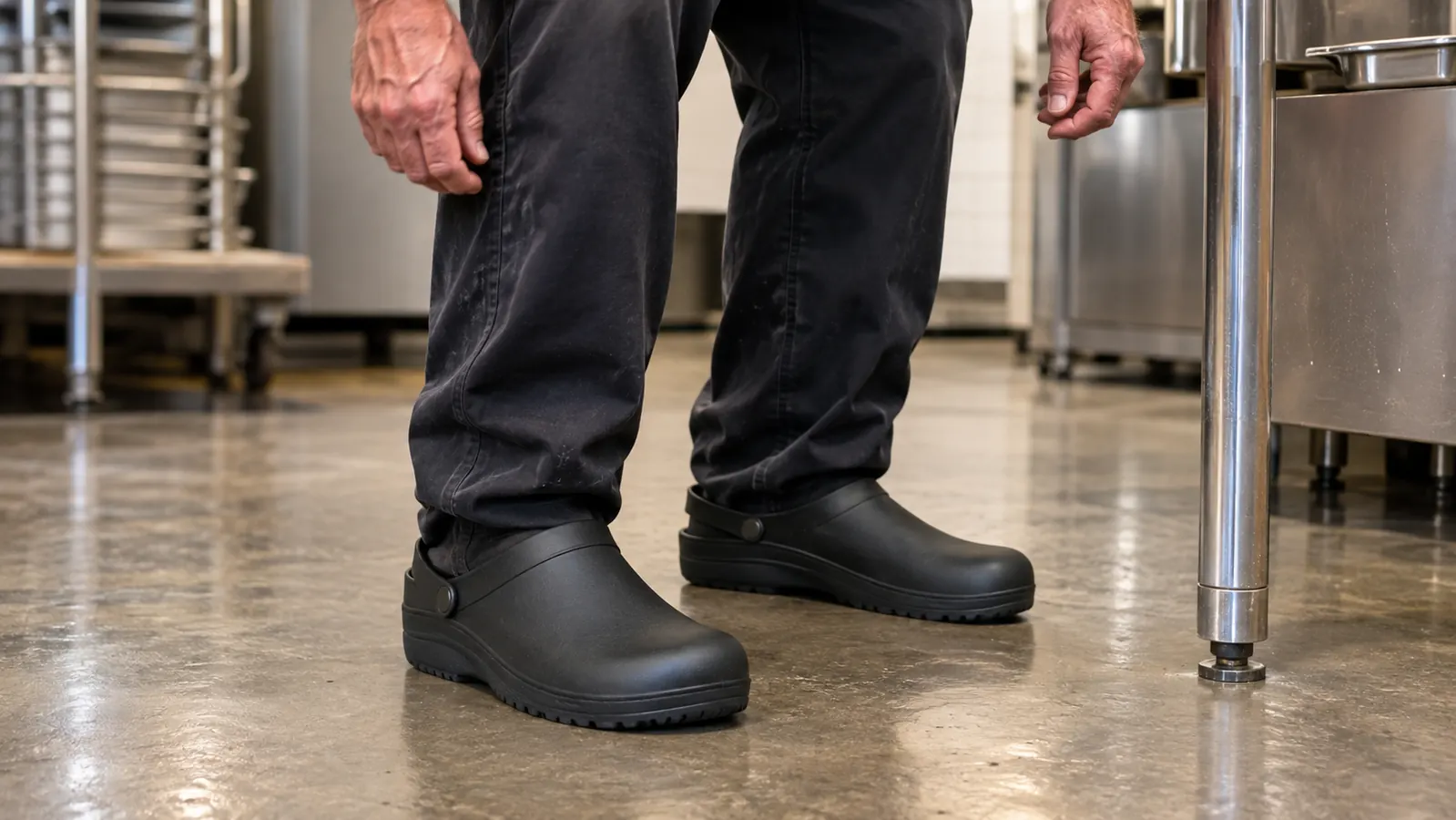
The reviews say comfortable out of the box, and they are. But comfortable is not the same as settled. A new Bistro is stiff, noticeably stiffer than the classic clog people buy for the garden. Molded EVA takes a while to warm up and give where your foot actually presses. For my first three shifts, the top of my right foot felt pressure right where the shoe bends at the toe. Not pain. More like a reminder that the shoe was there, and it was still there at hour six.
I remember the Thursday of that first week specifically. We had a school lunch order, three hundred sandwich halves, and I was at the bench from six in the morning until almost two without sitting down. By hour seven the pressure at the toe bend had gone from a reminder to a genuine ache, and I swapped into my old sneakers for the last hour and a half. The next Thursday I did the same order in the Bistro and never thought about my feet once. That was the shape of the break-in for me. Not gradual, more like a switch that flips somewhere in the second week.
That stiffness faded by the end of the second week and has not come back. What did not fade as quickly was the sizing question, and this is the part I wish someone had written plainly instead of saying true to size and moving on. A clog is not a sneaker. There are no laces to take up slack, and there is no way to change how the upper sits on your foot once you have picked a size.
Sizing, Plainly
I wear a women's 8.5 with a forefoot that is wider than the length suggests. The Crocs Bistro comes in whole sizes, so a half size is not an option. That leaves a choice. Take your true size and accept a snug length with a roomy toe box, or go up a full size and get a shoe that slides when you walk. I took my true size and it has been right. The closed toe gives my toes room to sit without pinching, the shoe does not feel short, and by the end of a shift there is no pressure across the top of my foot.
What helped me decide was measuring, which sounds fussy and takes about two minutes with a piece of paper and a pencil. Stand with your heel against a wall, mark the tip of your longest toe, and measure the distance. Mine came out at just over nine and three quarter inches, which put me in the 8.5 range with room to spare rather than at the very top of it. If your number lands right at the end of a size, that is the case for going up, not your usual habit. I would not size up simply because it is a clog, which is the advice I see most often and the advice I ignored.
If your feet run narrow, this is where the Bistro gets awkward. There is no lacing to pull the upper in, so a narrow foot will move around inside the shoe. A thicker sock helps. Going down a size helps more, but only if your toes still clear the front. Past that there is no adjustment, and pretending otherwise would waste your time and your return shipping.
Ten hours on sealed concrete and I drove home with them still on, because my feet did not need rescuing. That is the whole review, honestly.
The Strap Does More Than You Think
The Bistro has an ankle strap, and that strap is the difference between a work shoe and a house shoe. With it behind my heel, the shoe stays on when I pivot between the oven and the prep table, which I do a hundred times a shift. A clog without a strap will come off mid-stride, and I have watched it happen to a new hire carrying a tray of rolls across the floor. He caught the tray. He did not catch the shoe.
When I get home I step out of them at the door without bending over, which matters more at 51 than it did at 30. That is the whole appeal of the design. Nothing to tie, nothing to lace, nothing to adjust while your hands are covered in dough. In a kitchen, that is not a small convenience. It is the reason I stopped wearing sneakers to work.
Slip Resistance on a Wet Floor
Nobody believes a slip-resistant claim until they are the one carrying a stockpot. Our floor gets mopped at two and again at close, and the walk-in has condensation on it most mornings. The Crocs Bistro's rubber sole holds a wet tile better than the sneakers I wore before it. I noticed the difference around the corner by the dish sink, a spot where I used to shorten my stride without thinking about it. After a month I stopped noticing the corner at all, which is the highest compliment I can pay a sole.
Two caveats, said plainly. No shoe grips every floor. Ours picks up a film of flour near the bench and on that I still walk carefully, same as anyone with sense. And this sole is built for wet indoor surfaces, not for weather. If your job puts you on gravel, in snow, or on a loading ramp in January, this is not the shoe for those ten minutes of your day. It is a grocery and kitchen shoe, and it is honest about that.

Hour Eight Is Where You Find Out
Any shoe feels fine at hour two. The real test is hour eight, standing at the bench rolling dough, when your feet have stopped being interesting. On concrete, a thin shoe sends everything up through the heel, and by Friday your calves are unhappy with you. The Bistro weighs 16 ounces for the pair, which is light for a work shoe, and the footbed is fairly flat with a low arch. Light matters more than people think when you are lifting your feet several thousand times a day.
Flat is where some people will come up short, and I am one of them. If you want a shoe that holds your arch without help, this is not it. The honest fix is a thin insert, which is what I did, and mine fits without crowding my toes. That is the tradeoff with a molded clog. You get lightness and cushioning, and you give up the structured support of a laced shoe with a real shank. I made that trade on purpose. You may not want to.
A few years back I had heel pain in my left foot that my doctor called plantar fasciitis. It settled with stretching, better shoes and rest, and not with any single product. I mention it because it changed how I read reviews. What I can tell you about the Bistro is smaller and more useful than a cure. My feet are less tired at the end of the week than they were in the sneakers I wore before, and I am not limping to the car on Friday. That is the whole claim. Anyone who tells you a clog fixes a foot is selling something.
How They Hold Up
Molded EVA does not crack the way leather does, but it does compress. After a season of ten-hour days, the footbed in mine has taken the shape of my foot, which is comfortable for me and useless to anyone else. That is worth knowing if you were thinking about a used pair, and it is the reason I buy new and rotate instead of stretching one pair across the week.
The scuff on the left shoe came from the corner of a speed rack in the back room, somewhere in the third month. It is shallow and it has not grown. What I actually watch is the line where the rubber sole meets the upper, and there is no separation on either pair yet. I also check the inside heel, where a molded shoe tends to wear thin from the way you kick them off at the door. Mine shows a shine there, which is normal, but no thinning. At this rate I expect a full year out of each pair, and I will take that on concrete.
Cleaning takes about a minute. Warm water, a rag, and the flour, grease and icing sugar come off. The unlined inside does not hold odor the way a fabric-lined shoe does, as long as you let them dry between shifts. Mine come off at the door and go on a rack, and neither pair in my rotation has a smell I would apologize for in a break room. If you wear the same pair five days running on a wet floor, no shoe will save you from that.
What I Liked
- Comfortable for a full ten-hour shift after the first two weeks
- Rubber sole grips wet tile, including the corner by the dish sink
- 16 ounces for the pair, light for a work shoe
- Closed toe, waterproof upper, wipes clean in about a minute
- No laces to deal with when your hands are busy
- No seams along the sides of the foot for water and flour to sit in
Where It Falls Short
- Stiff for the first week or two, right where the shoe bends at the toe
- Whole sizes only, so no half size for a wide forefoot
- Thin under the arch, an insert is close to required if you want support
- Not a shoe for gravel, snow or an outdoor loading ramp
- The molded footbed takes your shape and is little use to a second wearer
Who This Is For
If you stand on a hard floor for eight hours or more and you are tired of replacing sneakers every few months, the Bistro is worth your money. Grocery, kitchen, deli, bakery, hospital hallways, a warehouse aisle. Anyone who walks on wet tile and would rather not think about their feet. It suits people who want one decision in the morning and no laces to deal with at 5:30 in the dark. It also suits a wide forefoot, which is the reason I keep buying them.
I would add one thing. Buy two pairs if you can. Alternating days gives each pair time to dry, and drying is the difference between a work shoe that lasts a season and one that smells like the walk-in by March. Both pairs in my rotation have held up, and they are worn the same amount, so I am not guessing about that.
Who Should Skip It
Skip it if you need arch support built in. Skip it if your shift includes gravel, snow, a freezer with an ice-slick floor, or a loading dock, because the sole was not made for that. Skip it if your foot is narrow and you cannot size down without your toes hitting the front. And skip it if you want a shoe that feels broken in on day one, because two weeks of stiffness is part of the deal.
That is not a long list of objections. It is a short one, and every item on it is something I would tell a coworker in the break room before she spent her money. What is left is a work shoe that does the job it advertises, for a fair while, without hurting you.
Two pairs, alternate days, and stop thinking about your feet by 6 AM
That is the whole method, and it is the reason my last pair made it a full season on concrete. Check the size chart first, since these come in whole sizes, then look at today's price on Amazon.
Amazon Check Today's Price on Amazon →