

I have been on my feet for a living since I was twenty nine. I manage the deli and bakery at a grocery store in Ogden, Utah, which means sealed concrete from 5:30 in the morning until a little after three, five days a week, twenty two years of it. My feet are a women's 8.5 with a slightly wide forefoot, and a few years back my left heel hurt badly enough that I went and had it looked at. So when a coworker asks whether she should buy the Dansko Professional, I do not hand her the version of this review that reads like the back of the box. I give her the three things that actually decided it for me, and two of them are complaints.
That is the point of this page. There are plenty of places to read that the Dansko Professional is a well loved work clog with a large following among nurses and kitchen staff. It is. What is harder to find is somebody telling you plainly that the first two weeks will not feel good, that the back of the shoe will try to walk off your heel, and that the break-in is not a small footnote you can skip past. So that is what this is. A straight account from somebody who has put in the shifts, including the parts that made me question the purchase before they made me glad about it.
The Quick Verdict
A genuinely good work clog that asks for two uncomfortable weeks up front. Buy it for the standing, not for the first impression.
Amazon Check Today's Price →Two hard weeks, then years of standing. That is the trade.
Most people take their usual women's size. Expect a break-in and give yourself a month before you judge them.
Amazon Check Today's Price on Amazon →What Nobody Tells You Before You Buy
Start with the part that gets skipped. A new pair is not comfortable on day one. It is firm under the arch and stiff across the top of the foot, and it does not flex with you the way a broken-in sneaker does. My first pair, years ago, I wore for a full ten hour shift on day two because I am not a patient person, and by three in the afternoon I was doing that thing where you stand on the outside edges of your feet to get the pressure off. That is not a defect in the shoe. It is what the shoe is before it becomes the shoe you love. But you should plan for it rather than be surprised by it in the middle of a rush.
The second thing is your heel. The closure is pull-on, so there is nothing to tighten. The back of the clog sits against your heel and relies on the shape of the shoe and the way you walk to stay where it belongs. For the first few weeks mine clomped. I could feel the back of the shoe drop away with each step and come back up again, and coworkers could hear me coming down the aisle from the far end. Most people find the heel settles once the footbed takes the shape of your foot, and mine did. But I want you to know it is coming, so you do not decide on day four that you ordered the wrong size and send them back.
The third thing is the weight. The listing puts them at 1.5 pounds. Compared to the mesh sneakers half my crew wears, that is noticeable, especially at hour nine when you are already tired and the truck has not been finished. It is also the reason the shoe feels as solid as it does under a long shift. Both of those are true at the same time. You do not get the firm platform without carrying it around all day, and anybody who tells you these feel light on the foot has not weighed them against anything.
How I've Used Them
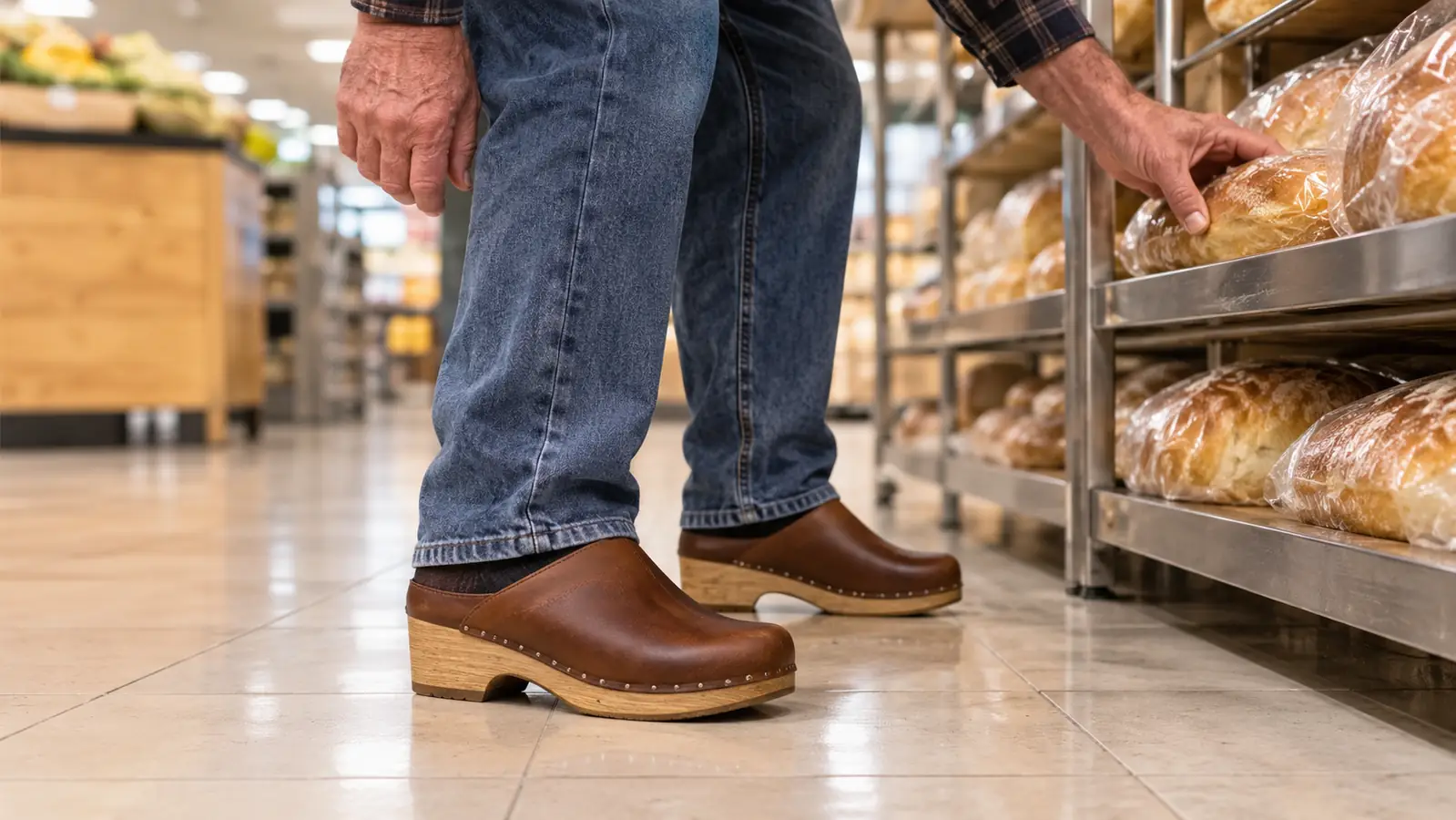
I keep two pairs and alternate days. That is not a shoe review tip, that is a deli manager tip, and it applies to every work shoe I have ever owned. Rotating gives each pair a day to dry out and it makes both pairs last longer. In a single week I am on tile behind the counter, sealed concrete in the back room, the cold floor of the walk-in cooler, and the rubber mats by the fryer. The Dansko handles all of it. The platform keeps my socks out of the spills that happen when somebody knocks over a bucket, and the closed toe has saved me more than once from a dropped stack of bakery racks.
Stain resistant is one of the listed features and I will tell you what that means in practice rather than in theory. Flour wipes off with a damp rag. Chocolate icing wipes off if you get to it before it sets. Grease from the rotisserie leaves a mark that fades over a few weeks but never fully goes. I have never had anything soak through to my sock, not once in all the years. After a couple of seasons the toes are scuffed and the finish has dulled down, which is exactly what happens to a shoe you actually wear to work. Do not expect them to stay looking new. Expect them to keep doing the job.
The cushioning is what I notice most at the end of a shift. Not soft, exactly. There is not a lot of squish in them. It is more that my feet are not furious with me when I get to the car, and that was not true of the flat shoes I wore before these. When my heel was bothering me a few years back, the firmness under the arch was the thing that made the difference between finishing a shift and limping through the last two hours of it. I am not going to tell you a shoe fixed my foot. It did not. Stretching, rest and time did. But the shoe stopped making it worse, and for somebody working ten hours on concrete, that is worth a great deal.
The Break-In, Week by Week
Weeks one and two are the worst of it. If you can, wear them around the house for a few evenings before you commit a full shift to them. I know that sounds fussy and I know you have a life. Do it anyway. The footbed is at its firmest and the top of the shoe is at its stiffest, and both of those soften with heat and time and your own body weight. If your job will let you, take them off at lunch for the first week. Ten minutes out of them at the halfway point makes the back half of the shift a different experience.
By week three the footbed has started to give where your foot actually presses and the top has relaxed across the instep. The heel still clomps, but less. By week five or six I stopped thinking about them, which is the highest compliment I can pay a work shoe. I put them on at 5:20 in the morning without a thought, the same way you put on your glasses. That is the point people are talking about when they say these last for years. It is not magic in the box. It is that the shoe ends up shaped like your foot, and once it is, it stays that way.
If you are buying your first pair at fifty one, the way a woman I work with did, give yourself a month before you form an opinion. She wore hers for one shift, hated them, and put them back in the box for two weeks. I talked her into a slow reintroduction, a few hours a day, and now she wears them five days a week and has stopped mentioning them, which from her is a rave. The shoe did not change. Her feet got used to it and the shoe got used to her.
Two years in, the toes are scuffed, the finish has dulled, and the footbed has taken the shape of my foot. That is what a work shoe is supposed to look like.
What They Get Right
The pull-on closure is the feature I would miss most if it went away. There are no laces to tie with flour on your hands and no strap to fight with when your fingers are cold from the cooler. I step into them at the start of a shift and step out of them at the end, and in between I can kick one off and back on without bending down if I need to. In a job where your hands are full most of the day, that is not a small thing. It is the difference between a shoe you wear and a shoe you avoid because putting it on is a chore.
The platform and the closed toe do quiet protective work all day. Hot water on the floor, a dropped can, a tipped container of stock, none of it reaches my foot. The listing notes that the shoe is APMA accepted, which is worth something if you are the type who likes a third party's opinion before spending your own money, and it also notes stain resistance, which I covered above. What those two things add up to is a shoe built with the understanding that work floors are not clean and work days are not short.
And they look tidy enough for the job I have. The listing calls the formality business casual, and that is about right. I can wear them with slacks for a manager meeting and with jeans on a Saturday and not feel like I am in the wrong shoes either time. Nobody has ever looked at my feet and commented. In twenty two years of retail that is more than I can say for some of the things I have worn.
What I Liked
- Holds up to a full ten hour shift on sealed concrete
- Pull-on with nothing to tie, easy on and off with full hands
- Closed toe and a raised platform keep socks out of spills
- APMA accepted and stain resistant per the listing
- The footbed takes the shape of your foot after a few weeks
Where It Falls Short
- Two to four weeks of break-in before they feel good
- The heel slips and clomps until the shoe settles
- Listed at 1.5 pounds, heavier than a work sneaker
- No adjustability, so the fit has to be right on day one
- Not the shoe for ladders, stairs or long walks

Where They Fall Short
If your day is up and down a ladder, these are not your shoe. The platform is firm and it does not flex the way a soft sole does, so you feel less of the rung under your foot and you have to be deliberate about where you place yourself. Same story with stairs. I take the back stairs at work a dozen times a day and I still notice them. In the aisles and behind the counter they are wonderful. On a ladder they are work. If your job is stocking high shelves all shift, try something with more flex before you commit.
They get warm. There is no mesh and no vent and nothing breathes the way a sneaker breathes. By August my feet are warmer in these than in anything else I own, and on a double shift in a kitchen with the ovens going I have been glad to change socks at lunch. That is the trade for the firmness and the protection, and I have made my peace with it. But if you run hot, or your workplace is already ninety degrees, know what you are walking into before the middle of July tells you.
And there is nothing on the shoe to adjust. No laces, no strap, no buckle, nothing you can loosen on a hot afternoon or snug up on a day your feet are swollen. That is the price of the convenience I praised two sections ago. It means the fit has to be right when the box arrives, because you cannot tune it afterward. It also means these are not a great choice for the second half of a pregnancy, or for anyone whose feet change size through the year, or for a person whose left foot and right foot are meaningfully different. That is a real limitation and I would rather say it than pretend the shoe suits everybody.
Sizing and the Wide Forefoot Problem
I wear an 8.5 and that is what I order. My forefoot is slightly wide and I have room across the ball of the foot without the shoe feeling loose at the heel. That combination is not automatic. With a pull-on shoe, the width you get is the width you get, so if your foot is genuinely wide rather than slightly wide, go find a pair to try on somewhere before you spend your money online. The closed toe means you cannot let your toes ride up against the front, and if they do you will know it by the second hour.
If you are between sizes, think about which problem you would rather have. Going down gives you a heel that stays put and a toe that may press. Going up gives you a toe with room and a heel that slips more than it already does. I would take the second one, because the heel settles as the shoe breaks in and the toe does not get longer. That is my opinion and not a rule, and it is worth exactly what you paid for it.
One more thing on fit. Buy them when your feet are at their normal size, not at the end of a hot day when they are swollen, and not first thing in the morning when they are at their smallest. The middle of an ordinary afternoon is the honest measurement. It sounds obvious written down. Almost nobody does it.
Who This Is For
This is a shoe for people who stand on hard floors for eight hours or more and have decided they are tired of their feet hurting at the end of it. Nurses, grocery and retail staff, kitchen crews, warehouse pickers, hairstylists, dental staff, anybody whose day is spent on tile or concrete rather than in a chair. It is also for people willing to give a shoe a few weeks to become comfortable, which rules out anyone who needs to be happy on day one.
It suits people who want one pair, or two, and want to stop thinking about footwear entirely. That is how I use them. I am not interested in the best shoe. I am interested in the shoe I put on at 5:20 in the morning without a decision, and this is that shoe for me. If you want a work shoe you can stop having opinions about, the Dansko Professional is a reasonable place to land.
Who Should Skip It
Skip it if your job involves ladders, scaffolding, or a lot of stairs. Skip it if you need something light, because 1.5 pounds is 1.5 pounds and your legs will know by hour nine. Skip it if your feet are wide enough that a fixed width is a gamble, since there is nothing on the shoe to loosen. And skip it if your employer requires a specific certified slip-rated outsole, because that is a question to put to the manufacturer directly rather than to a review, mine included.
And skip it if you are not going to give it a month. I mean this kindly. A person who wears a new pair for one shift, decides they are bricks, and returns them has not really tried them, and she would have been happier with a cushioned sneaker that feels good immediately and wears out in a year. The Dansko asks for patience and pays it back slowly. If that is not a trade you want to make, there is no shame in picking something else.
If you can give them a month, they will give you years.
Order your usual size, plan a slow break-in, and keep a second pair to rotate so both last longer. That is the whole method.
Amazon Check Today's Price on Amazon →