

Twenty-two years of ten-hour shifts on sealed concrete and I can tell you exactly where it shows up first. Not my back. My feet, and specifically the spot behind the ball of my left foot, which starts to ache around hour six and then keeps a running commentary until I clock out. I manage a deli and bakery, so I am not standing still for a living. I walk the floor, duck into the walk-in cooler, haul tubs, pivot between the slicer and the register, and squat down to reach the low shelves where the backstock lives. Standing in one place would almost count as a rest.
I have worked my way through the cheap foam insoles that flatten by Thursday, and the stiff ones that felt like standing on a ruler. Somewhere in the middle are these, the Dr. Scholl's Work All-Day insoles in the women's version, one pair, trim to fit, which is what this review covers. I have worn them five days a week for about three months, ten hours a shift, across two different pairs of work shoes. Here is what they do, what they do not do, and how I would hand them to a coworker in the break room.
The Quick Verdict
A soft, genuinely shock-absorbing gel layer that takes the sting out of concrete and holds its shape for months. Modest arch support, so do not expect correction, only cushioning and a little less ache at the end of the day.
Amazon Check Today's Price →The pair I keep a spare of in my locker
If your shift is ten hours on a hard floor and your feet are the reason you sit in the car before driving home, these are the cushioned pair to start with. Trim to fit, one pair per box, women's sizing.
Amazon Check Today's Price on Amazon →How I've Used Them
I wear a women's 8.5 with a slightly wide forefoot, which matters for trim-to-fit because you are cutting the insole yourself. I pulled the factory insole out of my work shoe, laid it on the Dr. Scholl's pair, traced around it with a fine marker, and cut with heavy kitchen shears. I cut the first one a hair large on purpose. You can always take more off. You cannot put it back.
The pair went into my main work shoes, and I kept my second pair of shoes on their normal factory insoles so I had something to compare against. I rotate shoes every other day so each pair has time to dry out, which is a habit I picked up years ago and would recommend no matter what you put inside them. That rotation also meant I was feeling the difference between the cushioned pair and the plain pair all week, every week, rather than guessing from memory.
My shifts start at 5:30 in the morning. That means the first two hours are cold, the middle of the day is warm behind the counter, and the walk-in cooler is a wall of cold air I step into maybe a dozen times a shift. My feet go from cold tile to cold cooler to a warm kitchen and back again. That is a specific kind of miserable for feet, and it is worth saying up front because it is not the same as a nurse doing twelve hours on one unit.
The first day I wore them I made the mistake of breaking them in on a Friday, which is our truck day. Forty cases of produce, two pallets of frozen, and a delivery driver who wanted every signature at once while the parking lot filled up behind him. I was up and down off my feet for nine hours straight and they were still talking to me at the end, but it was a tired sort of talking instead of the sharp ache I was used to. Saturday I wore the plain pair, and I felt the difference within the first hour.
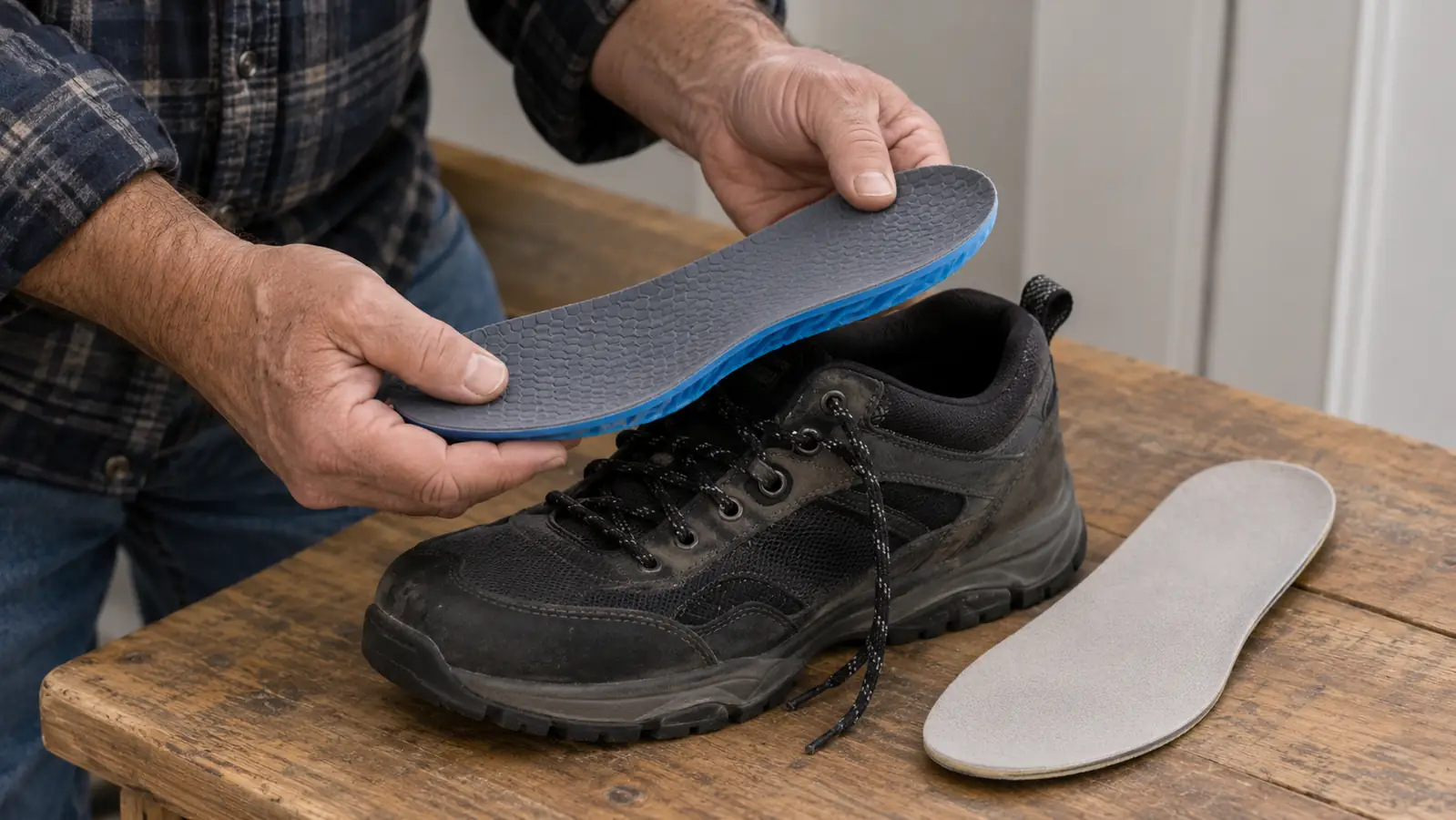
What Trim to Fit Actually Means in Practice
Trim to fit is not a marketing phrase, it is a chore, and the quality of your first ten minutes with these decides how the next three months go. The pair comes as a single women's size meant to be cut down to your shoe, so the fit is only as good as your tracing. Use the insole that came with your shoe as the template, not your bare foot. Shoes have a shape and your foot has a different shape, and you want the insole to match the shoe.
Cut from the toe end, not the heel. The heel is where the gel cushioning is thickest and where the shape matters most, so leave that end alone. Take the toe down in small passes, test it in the shoe, and only then trim the second insole to match the first. If you have a wide forefoot like mine, check that the trimmed edge is not curling up against the side of the shoe when you slide your foot in. A curled edge is a hot spot waiting to happen.
I also learned to cut to the line, not near it. My first one came out a little wide, which left a thin rim of material pressing against the inside wall of the shoe. That rim is where the soft rubbing sound came from later, and it took a second pass with the shears to settle it. For the second insole I cut exactly on the line and then laid both flat on the counter together to check they matched. Cutting the second one to the first is faster and more accurate than tracing your shoe twice.
One thing to plan for: the insoles take up volume. In a roomy work shoe this is nothing. In a shoe that was already snug across the top of your foot, the Dr. Scholl's pair will make it snugger, and you may need to loosen the laces or go half a size up in the shoe itself. I tried them first in a tighter pair and gave up on that shoe within a day. The second pair had more room and the insoles settled in immediately.
The Gel Layer, the Arch, and the Odor Detail
The part that earns its keep is the gel. These are a gel insole with gel cushioning concentrated where your foot lands hardest, and the shock absorption is the whole reason to buy them. On concrete, the difference is not subtle. My heel strike stopped sending that thin jolt up through my leg, and by the end of a shift my feet felt tired rather than bruised. Tired is normal. Bruised is what I was trying to get away from.
The arch is where I want to be straight with you. The listing describes this as an arch support insole built for a low arch, and that is what it feels like, a gentle lift under the middle of the foot rather than a hard shelf. If you have a high arch or a diagnosed problem that needs real correction, this is not that product, and the low-arch design is exactly why it feels comfortable to someone like me instead.
The detail I did not expect to care about is the Polygiene StayFresh treatment, which is there for odor control and to cut down on moisture buildup. I spend half my shift stepping in and out of a cooler, and my work shoes get damp in a way that has nothing to do with the weather. Three months in, the insoles do not smell like much of anything, which is more than I can say for the foam pair they replaced.
Three Months of Ten-Hour Shifts
The first week was an adjustment. Any cushioned insole changes how your foot sits in the shoe, and my calves noticed before my feet did. That passed by day four or five. Week two was where I stopped thinking about my feet at all, which after twenty-two years on concrete is not a small thing to be able to say.
By month two the gel had compressed slightly under the ball of my foot, and I could feel a shallow depression there when I slid the insole out to check it. That is normal for gel and it did not change how they felt underfoot. The top surface held up better than foam does. No tearing at the toe, no shredding along the cut edge, no rolling up at the sides.
One Saturday in that second month I worked a double because the closer called in sick. Six in the morning to a little past seven at night, with two short breaks and a lot of standing at the slicer. I did the whole thing in the cushioned pair. I was wrecked by the end of it, but the wreckage was in my knees and lower back, not in my heels, and that is the first time I can remember saying that about a shift that long. On the plain insoles I would have sat in the driveway before I could face walking into the house.
Month three is where I started watching for the usual failure signs, and I did not find them. The cushioning is still there. What has worn is the freshness, mildly, and the pair now lives in my second-choice shoes rather than my main ones. For the cost of a pair, getting a full season of shifts out of them before they go soft is a reasonable deal, and I would rather replace these twice a year than baby a pair of insoles I am afraid to get dirty.

What They Do Not Fix
These are cushioning, not correction. I had a stretch of heel pain in my left foot a few years back that my doctor called plantar fasciitis, and it settled down with stretching, better shoes, and actually taking my days off. The Dr. Scholl's pair made that foot feel better during the day. It did not treat anything, and I would not tell a coworker with real heel pain that a pair of insoles is the answer, because it was not the answer for me.
They also do not add much structure. There is no deep heel cup to speak of and no firmness through the middle of the foot, so if your complaint is that your foot slides around or that you need support holding your arch in place, these will disappoint you. They are soft in a way that some people will love and some people will find too squishy to trust on a ladder or a wet floor.
Last thing, and it is small but real: they can squeak. In one of my shoes the trimmed edge rubbed the sidewall and made a soft sound with every step for the first week. It went away once the edge softened, but if you are on a quiet sales floor, trim carefully and test the fit before you commit.
What I Liked
- Real shock absorption under the heel and ball, noticeable on sealed concrete by the end of a shift
- Gel holds its shape for months instead of flattening like cheap foam
- Polygiene StayFresh treatment keeps a damp work shoe from turning into a problem
- Trim to fit lets you size it to a shoe you already own instead of buying new shoes
- Low profile enough to wear under the factory insole of a roomier shoe
Where It Falls Short
- Arch support is modest, and the low-arch design will not suit everyone
- You are cutting them yourself, and a sloppy first trim ruins the fit
- Takes up volume, so snug shoes become too tight
- No real heel cup or firm structure for people who want correction
- Trimmed edges can squeak against the shoe for the first week
By week three I had stopped thinking about my feet by the time I got to the car, which after twenty-two years on concrete is not a small thing to be able to say.
Who This Is For
If your job is a standing job on a hard floor and your main complaint is that your feet and legs ache by the end of the day, this is the right starting point. Nurses, grocery and retail staff, warehouse pickers, kitchen crews, hairstylists, anyone who looks at the schedule and counts the hours rather than the tasks. The gel does the one job it is designed for, which is taking the edge off a hard surface, and it does it for months.
It is also a good fit if you already have work shoes you like and just want a better footbed inside them. Trim to fit means you are not shopping for new shoes on top of everything else, and one pair per box means you can try them in a single shoe before committing the second one. If you keep two pairs of work shoes and rotate them, buy two pairs of insoles and swap them out with the shoes.
Half the deli crew has asked me about them by now, mostly because I stopped sitting down on my break. Two of them bought a pair, and they happen to be the two who stand the most. The nineteen-year-old who did not has never had a foot hurt in her life, and honestly, she should keep it that way and keep her money. These are for feet that have started complaining, not for feet that are still fine.
Who Should Skip It
Skip these if you need actual arch support or correction. The low-arch design is gentle by intent, and if a doctor or a fitter has told you that you need firm support under the arch, this is the wrong product and no amount of cushioning will make up for that. The same goes for anyone with a diagnosed foot problem that is being managed. Ask about a custom orthotic, not a gel insole from a grocery aisle.
Also skip them if your shoes are already tight across the top, or if you wear a work boot with a very particular footbed shape that you do not want to disturb. And if you want a firmer, more structured feel underfoot, the soft gel will read as too vague. That is not a flaw in the product, it is a different job than the one you are hiring for.
Start with one pair, cut carefully, and see how hour eight feels
Three months in, this is the pair I recommend to coworkers who ask why I am not limping at the end of a shift. Order the women's trim-to-fit pair, use your shoe's own insole as the template, and cut from the toe end.
Amazon Check Today's Price on Amazon →