
At 5:30 in the morning, before the first customer walks past the bakery case, I am already on my feet. I have been doing ten-hour shifts on sealed concrete for twenty-two years at a grocery store in Ogden, Utah, and I have learned that a work clog only stays comfortable if you clean it on purpose. Crocs Bistro clogs are the pair I keep by the back door. They are lightweight, they have a closed toe, and the listing calls them waterproof. But waterproof is not the same as self-cleaning.
The problem is the stuff that builds up. Flour paste from the bakery. A little pickle brine. Syrup from a spilled bottle. The dull film that shows up on any shoe after a week of walking between the sales floor, the back room and the walk-in cooler. If I ignore it, the clog starts to look tired, the sole gets slick in the wrong places, and I trust my footing less. The fix is not complicated. It takes about ten minutes, a sink, a cloth and a brush. The trick is doing it before the buildup hardens.
Clean them before the concrete teaches you a lesson
These are the work clogs I wear for ten-hour deli shifts. Closed toe, slip resistant, waterproof, and easy to wipe down at the end of the day.
Amazon Check Today's Price on Amazon →What Causes the Buildup
Most of what lands on a work clog is not mud. It is food, floor finish and water. In a grocery store, the bakery dust is fine and sticky. The deli has brine, oil and sanitizer. The walk-in cooler has condensation. The sales floor has whatever came in on a hundred pairs of shoes before yours. All of that gets packed into the sole and onto the sides of the clog.
Waterproof helps on the outside. The Crocs Bistro upper is EVA, and the listing says it is unlined, so there is no fabric inside to hold a puddle. But a waterproof shoe still gets dirty. The difference is that the dirt sits on the surface instead of soaking in. That is good news. It means you can clean it instead of replacing it.
The Five-Step Routine
This is the routine I use on Sunday afternoon, after the shift and before the week starts again. It works on the Crocs Bistro pair I wear now, and it worked on the pair before that. You do not need a special cleaner. You need ten minutes and a place where the clogs can dry overnight.
Step 1: Knock Off the Dry Stuff
Take the clogs outside or hold them over a trash can. Clap the soles together a few times. Use a stiff dry brush on the tread to lift out flour, crumbs and whatever dried on the floor during the week. Do this dry. If you start with water, you turn dust into mud and push it deeper into the tread.
Check the ankle strap and the closed toe while you are there. The strap is the part that takes the most pulling when I am in a hurry. If it feels gritty, brush it off before you wet the whole shoe.
Then set them on a towel. You are not trying to make them look new yet. You are getting the loose layer off so the wash water can do its job.
Step 2: Wash the Outside with Mild Soap
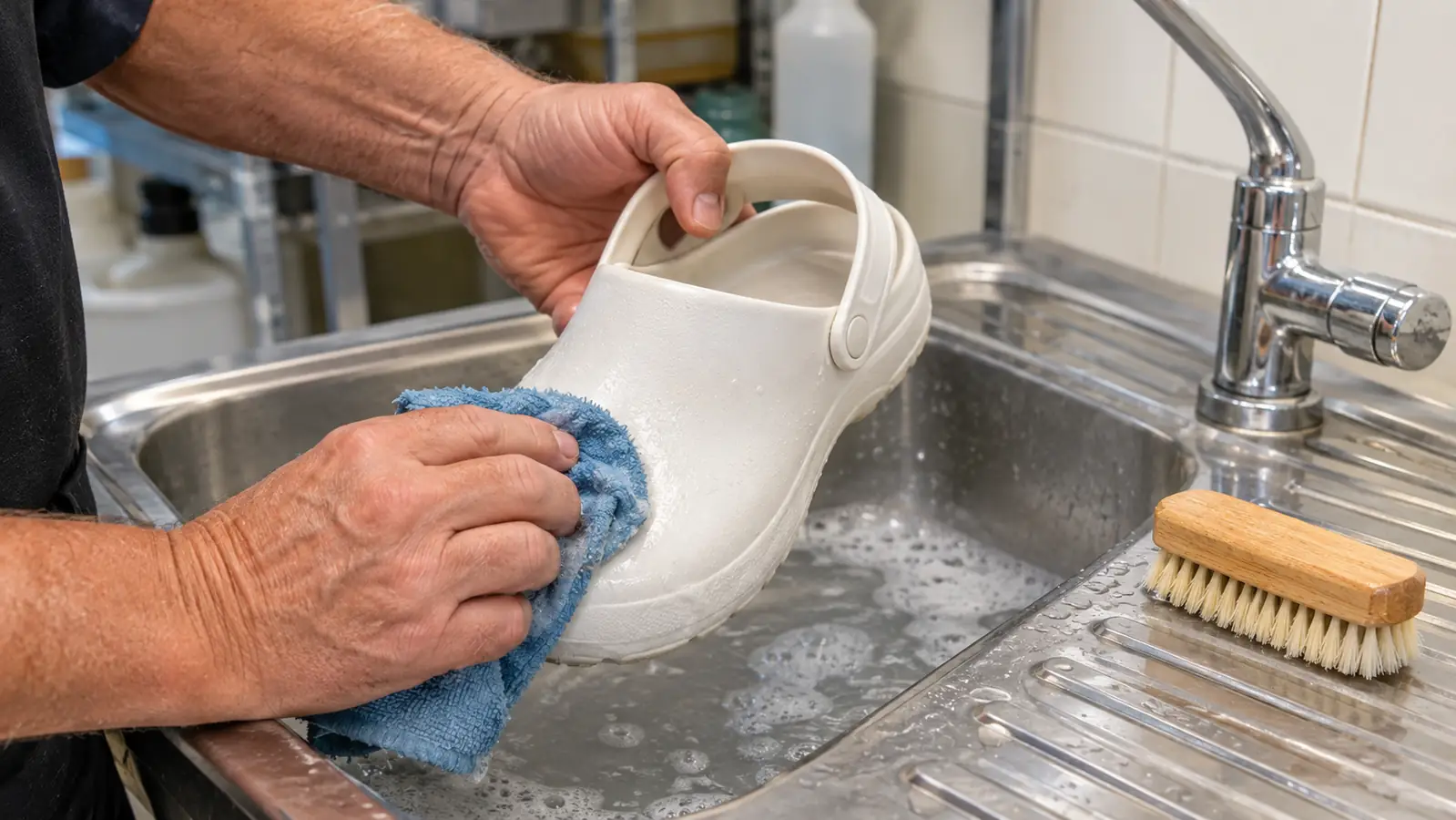
Fill a sink or a bucket with warm water and a small squirt of mild dish soap. Not hot. Hot water is hard on the EVA upper and it is hard on your hands at the end of a shift. Use a soft cloth or a non-scratch sponge. Wipe the closed toe, the sides and the ankle strap. The upper is unlined EVA, so there are no seams to dig into and no fabric to soak.
For the rubber sole, use a stiff brush. Scrub across the tread, not just along it. The grip is in the little edges, and that is where the syrup and the floor wax collect. If a spot does not come off, let the soapy water sit on it for a minute and come back. Do not reach for a metal scraper.
Rinse with clean water. If you leave soap on the surface, it dries into a film that looks like dirt and feels a little slick. Rinse until the water runs clear.
Step 3: Clean the Inside Without Soaking It
Turn the clog over and look inside. The interior is unlined, so it is easy to wipe, but it is also easy to overdo. Mix a little mild soap with water on a cloth and wipe the inside surface. Do not fill the shoe with water and let it stand. You are cleaning a surface, not giving it a bath.
If the inside has a smell, sprinkle a little baking soda in, let it sit for an hour, then brush it out. I do this on a Saturday afternoon when the pair is already dry. It is not a chemical fix. It just helps with the damp sock smell that builds up after ten-hour shifts.
Wipe the inside with a clean damp cloth and set the clog where air can move through it.
Step 4: Dry Them Right
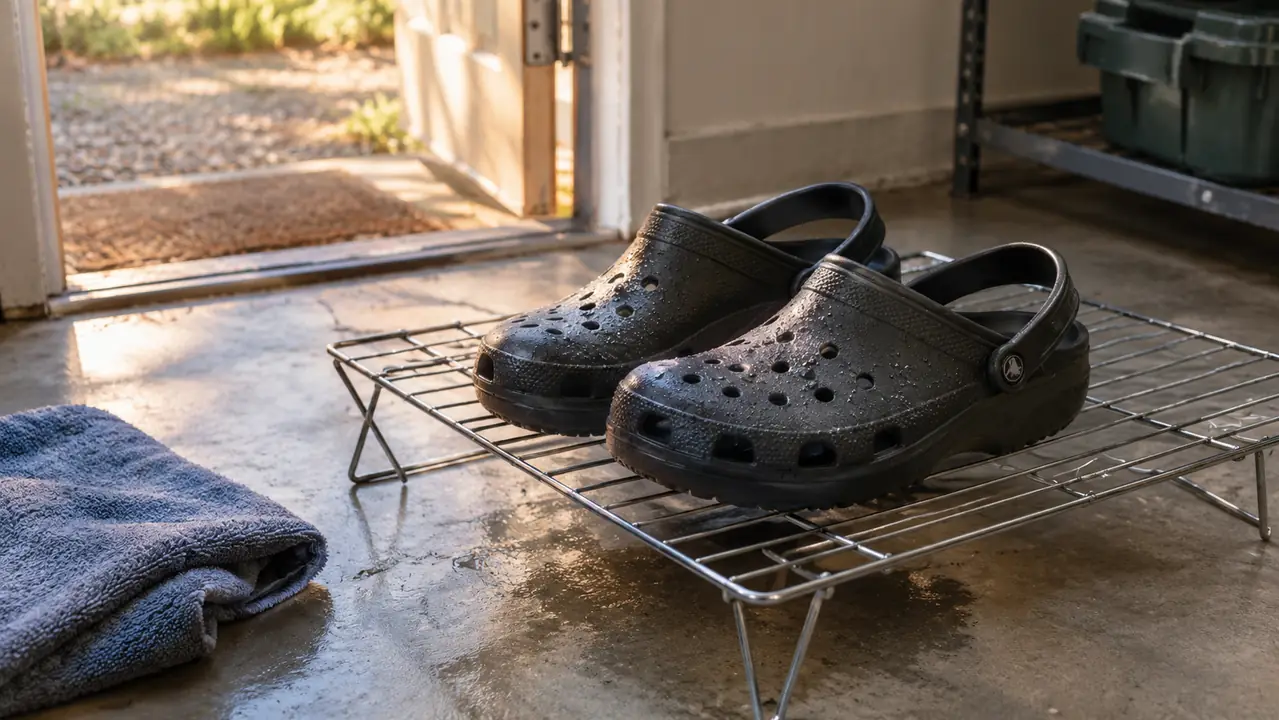
Air dry only. Set the clogs on a wire rack or a boot dryer that does not heat. Keep them out of direct sun and away from the radiator, the oven or the back of a hot truck. Heat is what warps EVA and shrinks a pair that used to fit. I learned that with a different pair years ago, and I have not done it since.
Stuff a dry towel inside if the clog is damp. Change the towel after an hour. Do not put them in the dryer. Do not leave them in a plastic bag. A clog that dries slowly with air keeps its shape better than one that is cooked dry.
Give them overnight. If you work early, clean them right after your shift, not at 5 AM.
Step 5: Check the Sole and the Strap Before You Wear Them Again
Once they are dry, turn them over. Run your thumb along the tread. If the edges are rounded off and the pattern is shallow, the clog is telling you something. The listing calls the sole slip resistant, and that is true when the tread is intact. A worn sole on a wet floor is a different shoe.
Check the ankle strap where it meets the shoe. Look for cracks or a stretched spot. Check the closed toe for deep gouges. A small scuff is normal. A split is not. The pair I keep in rotation gets a look every Sunday, and I replace them when the sole stops feeling sure under me.
Wipe the whole clog with a dry cloth and put them back on the rack. That is the whole routine.
The Daily Wipe Down
The Sunday routine is the deep clean. The daily wipe down is what keeps you from needing a deep clean every week. When I finish a shift, I take a damp paper towel and wipe the closed toe and the sides of the clog. It takes twenty seconds. It gets the flour paste before it turns into a hard shell.
I also keep a small brush by the back door. If I see something in the tread, I knock it out before I go inside. That is not neatness for its own sake. A clog with a clean tread grips better on a wet floor than one with a packed layer of flour and floor wax.
A Note on the Strap and the Fit
The ankle strap is there for a reason. When I am moving fast between the deli case and the back room, I want the clog to stay with me. The strap helps. It is not a lace-up shoe, and I do not treat it like one. If the strap feels loose, check that the clog is dry and that the strap has not stretched. A wet clog can feel loose because your foot slides. Dry it before you judge the fit.
The pull-on design is one of the reasons I still wear this style. I am not bending over to tie laces at 5:30 in the morning with a tray of muffins in my hands. I step in, the strap does its job, and I go. The closed toe protects me from a dropped can or a rolling cart. The 16 ounces listed on the product page is light enough that I am not thinking about my feet by the third hour.
What Else Helps
Rotate two pairs. I keep two pairs of work shoes and alternate days so each pair dries out. That is not brand loyalty. It is just physics. One pair airs out while the other works. The Crocs Bistro pair I wear on Monday is not the same pair I wear on Tuesday, and both last longer because of it. My husband Dale works road construction, and he does the same thing with his boots.
Wear socks that wick. Cotton holds sweat against your foot all shift. A thin wool blend or a synthetic work sock makes a difference in how the inside of the clog smells at the end of the day. Change socks at lunch if you can. It sounds like a small thing. It is not.
The listing lists a low arch. I do not pretend this clog is a custom orthotic. If you need more arch support, that is a conversation with someone who fits inserts, not a cleaning article. My left foot has a history of plantar fasciitis. It settled with stretching, better shoes and rest, and I am careful about what I stand in. Cleaning a clog is not a treatment for anything. It is one less thing working against me.
The ten minutes I spend on Sunday is the difference between a clog that feels sure under me on a wet floor and one I am babying all shift.
When to Replace Them
A work clog does not fail all at once. The upper starts to look dull no matter how you clean it. The inside takes on a smell that baking soda no longer fixes. The tread gets smooth in the spots where you push off. Those are the signs I watch for.
The sole is the part that matters most on a wet floor. The listing calls the Crocs Bistro sole slip resistant, and it is, as long as the tread has edges. Once the pattern is worn down, you are standing on a flat rubber surface. That is not a cleaning problem. That is a replacement problem. I would rather buy a new pair than find out the hard way in the walk-in cooler.
Check the strap and the closed toe too. A crack in the strap or a split at the toe is not something soap will fix. If the clog fits well and the sole is still sharp, keep cleaning it. If the sole is smooth and the strap is tired, let it go. The pair I keep by the back door gets replaced when the tread stops feeling sure, not when it looks bad. Looking bad is normal. Feeling unsure is the signal.
A clean pair of work clogs is one less thing to think about at 5:30 AM
If your current pair is worn smooth or the strap is giving out, start with the Crocs Bistro clog I wear for ten-hour shifts on sealed concrete.
Amazon Check Today's Price on Amazon →