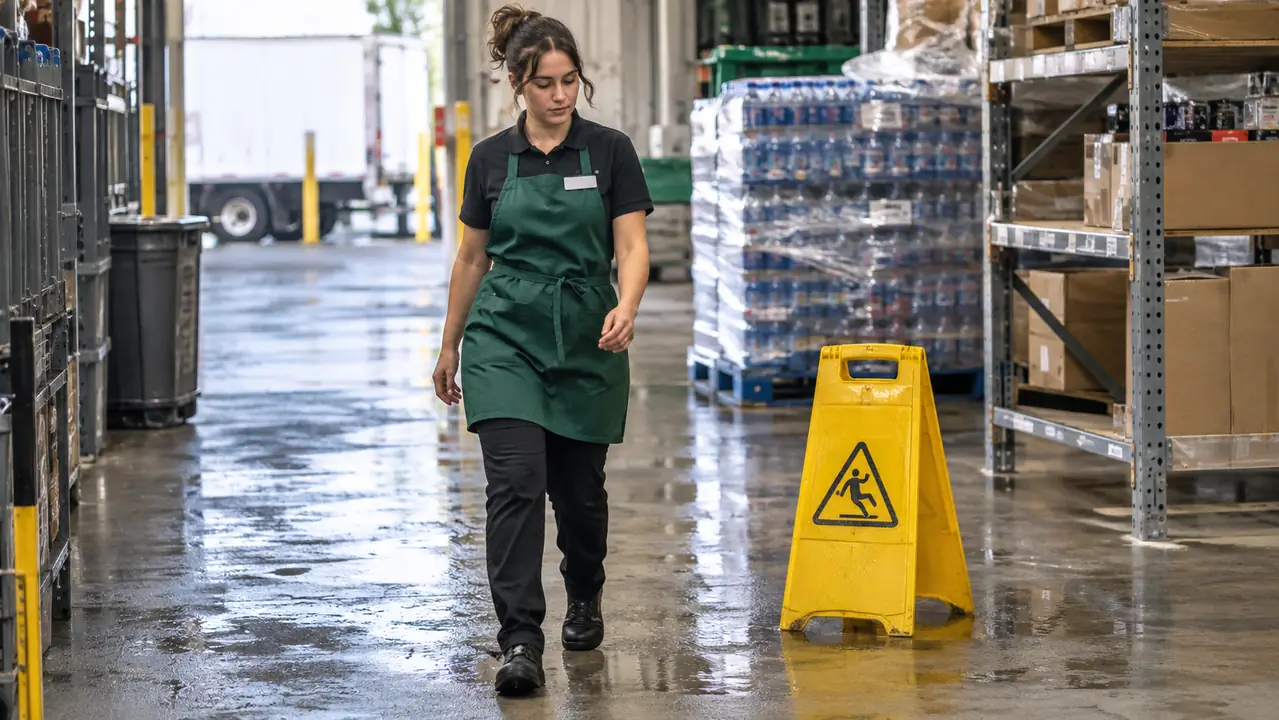
Twenty-two years into ten-hour shifts, I can tell you the exact spot in our store where I used to slip. It is the transition strip between the sales floor and the back room, where the mop water pools and the tile changes under your feet. I caught myself there twice in one month, once carrying a tray of sandwich wraps. Nobody saw it either time. That was the month I stopped buying work shoes for how they looked and started buying them for the floor I actually stand on.
Most slipping on the job is not bad luck. It is a smooth outsole, a tread worn flat, a heel that slides, or a floor that stays wet longer than anyone wants to admit. You can fix a good part of that with the right shoe and a few habits that do not take any extra time. The pair I have settled into for my own shifts is the Skechers Work Relaxed Fit D'lux Walker SR Ozema slip-on. I am going to walk through what I check before I buy, how I break a pair in, and the floor habits that keep me upright when the mop bucket comes out.
The work sneaker I reach for on wet-floor days
The Skechers D'lux Walker SR Ozema is a slip-on work sneaker with slip-resistant and water-resistant features, a memory foam insole, a closed toe and a lightweight build at 2 pounds. It is the pair I keep by the door for 5:30 AM shifts.
Amazon See today's price on Amazon →Step 1: Flip the shoe over before you look at anything else
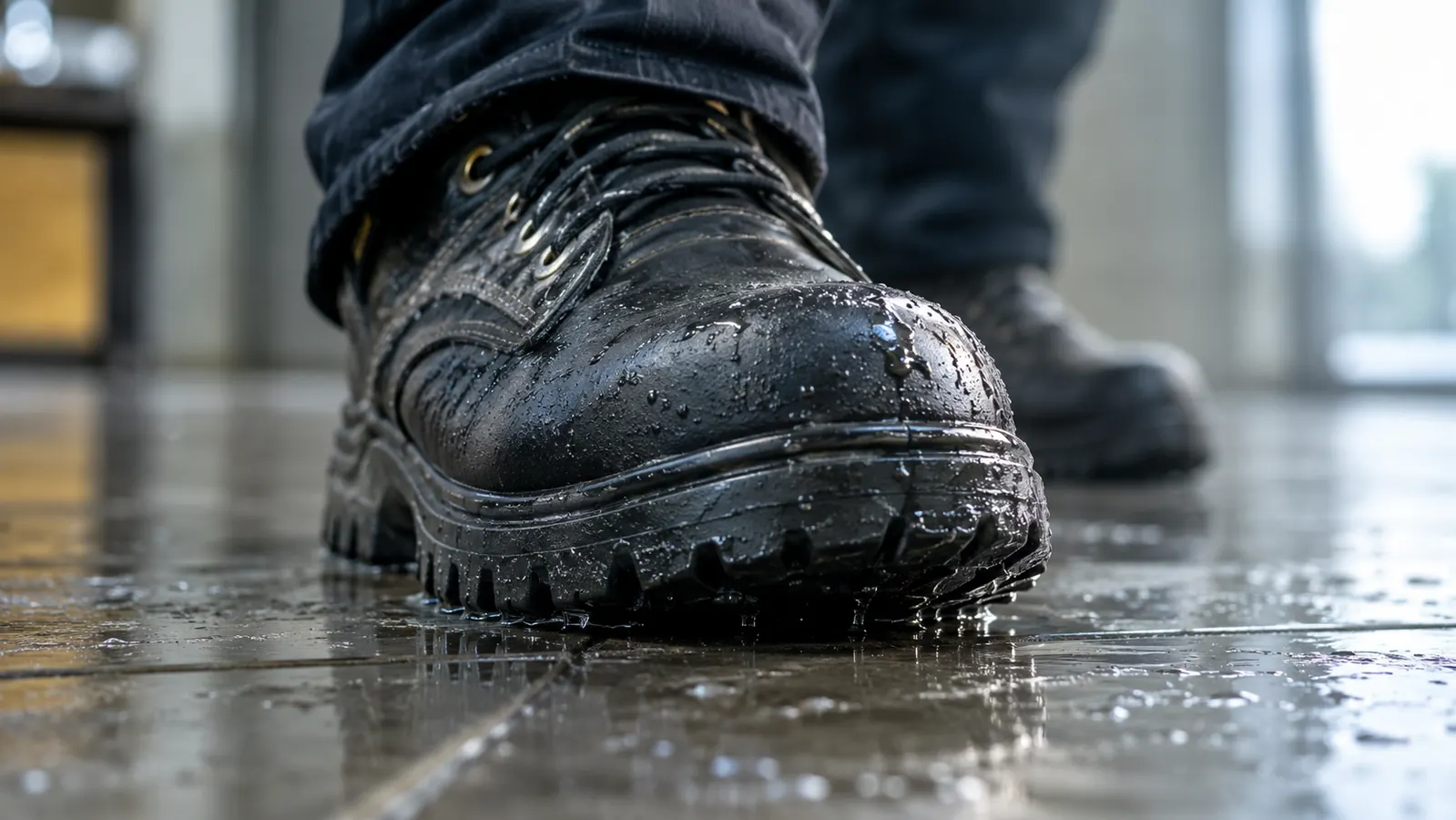
The first thing I do in the store is turn the shoe upside down. Not the upper, not the stitching, the bottom. A shoe that is going to hold on a wet floor needs a tread with open channels that push water out from under your foot instead of trapping it. Deep grooves and a softer, tackier compound give you more surface in contact with the floor. A hard, smooth sole is what you get on a fashion sneaker, and it is what sends people down in a hurry.
You will see slip resistance listed on the tag or the box on some work shoes and not on others. It is worth asking about, especially if your employer buys the shoes. The Skechers D'lux Walker SR lists slip resistance as a special feature, and that is the first box I check now. It also lists water resistance, which is not the same as waterproof. Water resistant means a splash or a wet floor is not going to soak straight through. It does not mean you can stand in a puddle.
My first attempt at fixing this was cheaper and dumber. I bought a pair of plain canvas sneakers because the sole looked textured in the photo. Three weeks in, the tread had worn smooth across the ball of the foot, and I went down in the walk-in cooler doorway on a Tuesday morning in November with a case of creamer in my arms. The creamer survived. My pride did not. That is when I started flipping shoes over before I paid for them, and it is why I do not trust a photo of a sole.
One more thing about the sole. Tread wears down. A pair that gripped well in March can be slick by October if you walk the same route every day. I check mine about once a month by running a thumb across the heel. When the grooves feel shallow and the edge is rounded off, the shoe becomes a house shoe and a new pair goes into the rotation.
Step 2: Match the shoe to the floor you actually work on
Wet is not one thing. There is mop water on sealed concrete, there is rain tracked in at the front end, there is dish water on quarry tile, and there is grease on the line in a kitchen. A shoe that handles a wet floor well can still be useless on a thin film of chicken fat. If you work in food service, tell the person selling you the shoe what your floor actually is. Ask what the slip rating was tested on.
In our store the worst spots are the walk-in cooler door, the corner by the baler, and the aisle where the floor scrubber turns. Those are the places I slow down no matter what is on my feet. On sealed concrete, a softer tread helps because the floor is smooth and hard. On tile with deep grout lines, you want a tread that does not skate across the grout. On mats, you want a flat sole that does not catch an edge and trip you.
I keep a mental map of those three spots, and I take them the way a driver takes a wet curve. Slower, wider, weight back. The corner by the baler got me once while a floor scrubber was running behind me. I did not fall, but my right foot went out from under me about four inches and I felt it in my hip for two days. After that I started walking the long way around the scrubber instead of straight through where it had just been.
No shoe is magic on grease. I have watched people go down in kitchens in every brand you can name. If the floor is greasy, the floor needs cleaning, and that is a conversation for your manager, not the shoe store. What a good slip-resistant shoe does is buy you a margin on the ordinary wet floor so you are not relying on luck at 6 AM.
Step 3: Get the fit right so the shoe stays under you
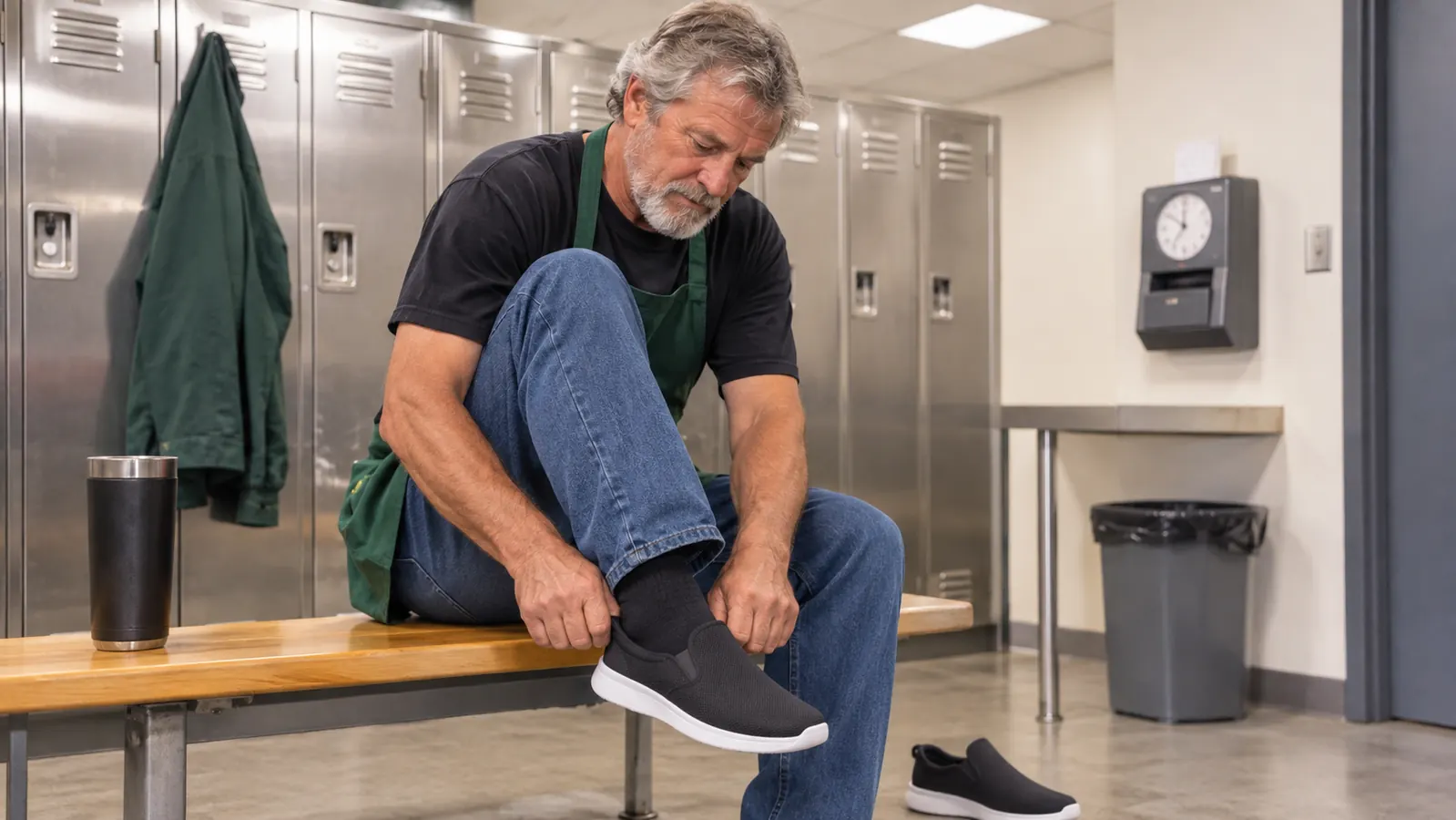
I wear a women's 8.5 with a slightly wide forefoot, and I have learned that a slip-on has to fit correctly from the first day, because there are no laces to tighten later. The D'lux Walker SR has a pull-on closure and a closed toe. That is comfortable and fast at 5:30 in the morning. It also means the shoe cannot be sloppy, or your foot will slide inside it and you will roll an ankle on a turn.
Sizing is the part people skip. I tried the 8 first because a slip-on can stretch, and I could feel my heel lift on the third step, so I went back up to my usual 8.5. If you are between sizes in a pull-on shoe, take the larger one only if the heel still holds. Otherwise take the smaller. A shoe that is a half size too long will let your foot slide forward on a downhill ramp, and grocery stores are full of ramps.
What I check: heel hold first. Walk five steps. If your heel lifts, the shoe is too big or too wide. Then the toe box. You want a thumb's width in front of your longest toe, and you want the widest part of your foot to sit at the widest part of the shoe. Then the arch. The D'lux Walker SR lists a cushioning arch and a memory foam insole, which is a soft ride rather than a firm support. If you need a hard orthotic, take it with you and try the shoe with it in place.
Two pounds for a pair is light for a work shoe. Light is good at hour eight. Light can also mean less structure, so pay attention to how the shoe feels when you turn, not just when you walk straight. If it feels like your foot is going to slide off the footbed on a corner, size down or try another width.
A hard, smooth sole is what you get on a fashion sneaker, and it is what sends people down in a hurry.
Step 4: Break them in at home and rotate two pairs
New work shoes go on for an hour at home first, on a clean floor, with the socks you actually wear to work. Then a short errand. Then a half shift. I know that sounds fussy. It beats finding out on a wet tile floor at 7 AM that a seam rubs your heel. The first week with the D'lux Walker SR, I wore them for the drive in and for the first half of my shift, then switched back to my old pair at lunch.
I keep two pairs and alternate days. That is the habit I recommend most, more than any single brand. Shoes absorb sweat and mop water, and a pair that never dries out gets soft and starts to smell. Alternating gives each pair a full day to dry. It also spreads the wear on the tread, so you are not replacing both pairs at once.
Water resistance helps here, but it is not armor. If I get caught in the rain in the parking lot, I stuff newspaper in the toes overnight and set them by the door, not on the heat register. Heat will break down the adhesive faster than water will. The pair that is still damp the next morning does not go on my feet for a ten-hour shift.
Step 5: Change the habits that cause most slips
Most of the slips I have seen at work were not caused by a bad shoe alone. They were caused by hurrying around a corner with your weight forward, or turning on the ball of your foot on a wet floor, or stepping off a mat onto tile without looking. Slow down for three steps before a corner. Take shorter steps on a wet floor. Turn with your whole foot, not just the front of it.
I learned that the hard way on a Saturday in February during a big sale week, when I came around the endcap by the dairy case at a near jog because the line was out the door. My left foot went one way and the rest of me went the other. I caught the shelf edge with my hand. Nothing broken, but I was shaky for an hour and had to sit down in the break room. Now I walk the corners. The customers can wait the extra two seconds.
Keep a rag at your station and wipe up what you spill, even if it is water. Report the leak by the walk-in that nobody has fixed for two months. Put a wet floor sign out and actually leave it out until the floor is dry. At home, wipe your soles on the mat before you come in from the rain, because whatever is on the parking lot comes in with you.
One more: keep your toenails trimmed and your socks dry. Small things, but a thick toenail or a bunched sock changes how your foot sits in a slip-on, and a shoe that fits on Monday can rub by Thursday. I keep a spare pair of socks in my locker. That is not a shoe problem. It is a long-shift problem.
What Else Helps
A few things outside the shoe make a difference. Good socks, changed at lunch if your feet sweat. A mat at your station if your manager will buy one, because standing on a mat is easier than standing on sealed concrete. Stretching your calves at break. I had heel pain in my left foot a few years back that my doctor called plantar fasciitis. It settled down with stretching, better shoes and rest. I am not going to tell you a shoe fixes that. I will tell you that a thin, worn-out shoe made it worse.
If you have a floor that is wet all day, no shoe is going to make it safe. That is a maintenance issue, and it is worth saying out loud. The D'lux Walker SR is what I wear while the floor gets fixed, and it is what I wear on the ordinary days when the floor is just damp. It has held up for me across ten-hour shifts. That is a modest claim, and it is the one I can stand behind.
If your floor is wet more often than not, start with the sole
The Skechers D'lux Walker SR Ozema is a lightweight, slip-resistant, water-resistant slip-on with a memory foam insole and a closed toe. It is the pair I keep in the rotation for wet mornings and long shifts.
Amazon Check today's price on Amazon →