
I bought my first pair of Skechers work shoes out of plain tiredness, not brand loyalty. It was a Tuesday, I had just shut down the bakery side at 4:15, and my left heel was doing the thing it does after three ten-hour shifts in a row. I sat in the parking lot with my shoes off and my feet up on the dashboard and ordered the Skechers D'Lux Walker SR slip-on on my phone. The reason was not complicated. The listing said slip resistant, and I was tired of walking carefully past the mop sink every time somebody dropped a bucket.
That was a while ago now. I have been through more than one pair since, I keep two in rotation so each one gets a day to dry out, and I have recommended them to a dozen people on my crew. Some of them love these shoes. At least two gave theirs away inside a month. This is the honest version of that: what the D'Lux Walker SR actually does well on a grocery floor, where it quietly stops being a good shoe, and the specific reasons people hand it back.
The Quick Verdict
A genuinely comfortable step-in work sneaker with a slip resistant outsole and a memory foam insole that earns its keep for about four to five months. Buy it for everyday comfort and easy on and off, not for arch structure that lasts.
Amazon Check Today's Price →The pair I keep by the door for a 5:30 AM shift
Slip resistant outsole, memory foam insole, pull-on closure, closed toe, and the roomier Relaxed Fit cut that suits a wider forefoot. Check today's price and what sizes are left.
Amazon Check Today's Price on Amazon →How I've Used Them
I am the deli and bakery manager at a grocery store in Ogden, Utah. Twenty-two years of this. Ten-hour shifts, in the door by 5:30 in the morning, five days a week. My workday runs across three different surfaces: tile behind the counter, sealed concrete in the back room and the production area, and the coated concrete in the walk-in cooler, which is the slickest of the three when it is damp. I am on all of them every day, plus the sales floor when I go out to help somebody find the rye bread.
I wear a women's 8.5 with a slightly wide forefoot. A few years back I had heel pain in my left foot that my doctor called plantar fasciitis. It settled down with stretching, better shoes and actually sitting down for my break, and I mention it only as background, because it is why I pay attention to insoles now. No shoe fixed that. Shoes helped me get through the day while the rest of it sorted itself out, and that is the standard I hold these to.
I judge a work shoe on four things, and none of them is how it looks in the box. Comfort at hour eight, not hour one. How easy they come off at the locker when my hands are sticky with dough. Grip on a wet floor when I am carrying something heavy and cannot see my own feet. And how they feel in the second month, because a shoe that only works for six weeks is not a work shoe, it is a rental. The D'Lux Walker SR is interesting because it wins two of those clearly and fades on the other two.
What You Actually Get
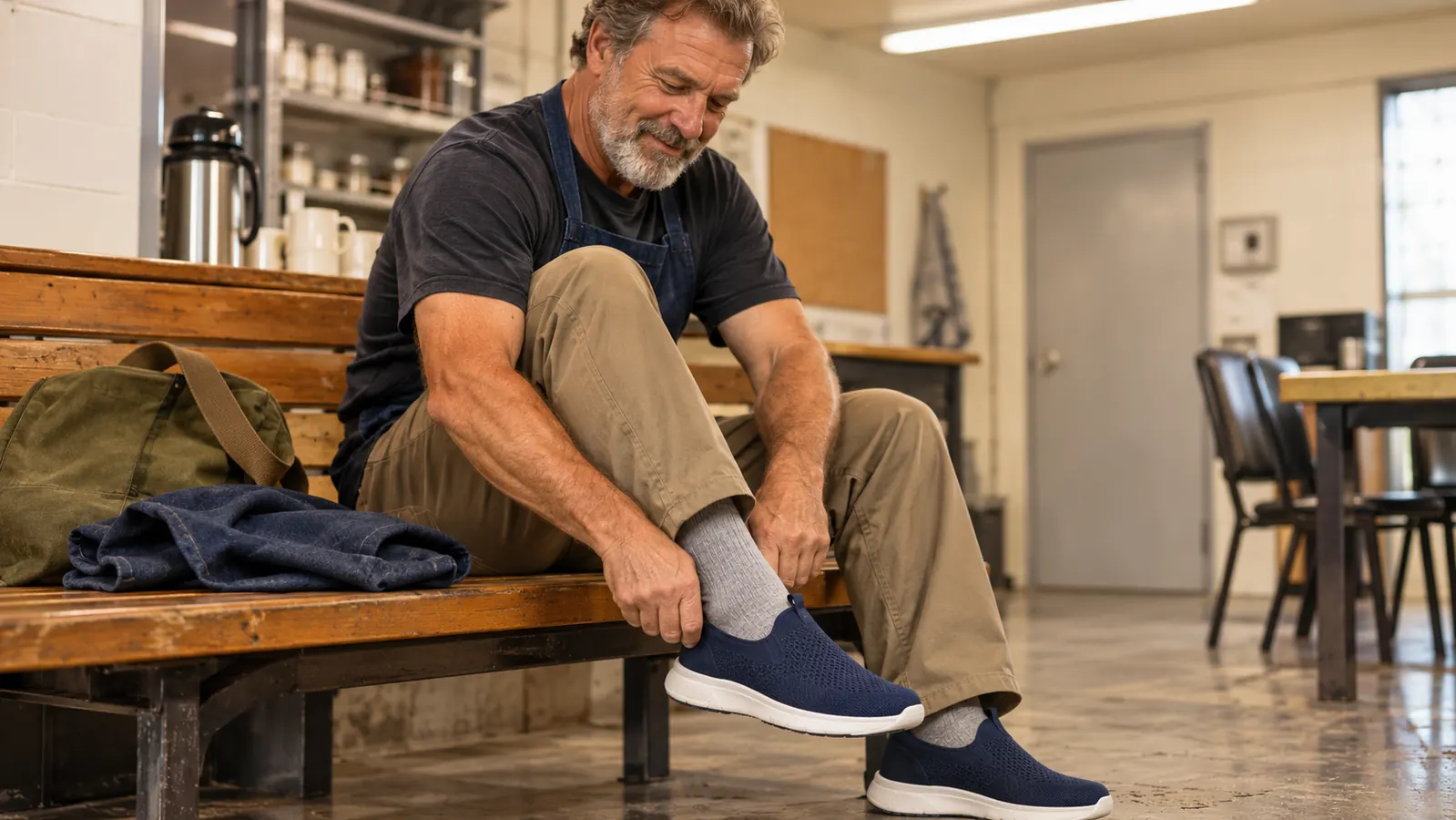
The listing is fairly plain about what this shoe is. Pull-on closure, so no laces. Closed toe. No heel. The pair is listed at about 2 pounds, which matters when you pick your foot up a few thousand times a day. A slip resistant outsole, which is the reason this is sold as a work shoe rather than a walking shoe, and listed as water resistant too. Inside, a memory foam insole with cushioning through the arch. And the Relaxed Fit cut, which is Skechers' roomier shape through the toe box.
In practice that adds up to a shoe you step into, not tie. Nothing to adjust, nothing coming untied at 6 AM when your hands are in a dough scraper, nothing pressing across the top of your foot. For anyone who walks in and out of a cooler and a wet production room forty times a shift, the slip resistant outsole is the feature that earns the shoe its place, and the memory foam is the feature that makes you want to put it on.
What I Liked
- Steps on with one hand, which matters at the start of a shift
- Slip resistant outsole that holds on wet tile and a damp cooler floor
- Memory foam insole is comfortable from the first day, no break-in
- Lightweight, about 2 pounds for the pair
- Listed as water resistant, so a spilled bucket is not a disaster
- Closed toe protects against carts and bread racks
- Relaxed Fit cut leaves room for a wider forefoot
Where It Falls Short
- Memory foam insole compresses around month four, well before the shoe is worn out
- Soft underfoot, with no firm structure for a tired arch in the afternoon
- Not waterproof, and not the shoe for standing water
- The pull-on collar loosens over a few months
- No adjustment at all, so a narrow foot will feel movement
- Tread wears at the outside heel edge first
- Realistically a five to seven month shoe with heavy use
The Parts Nobody Puts in the Headline
Here is the first thing I would want somebody to tell me. The memory foam insole is the whole reason this shoe feels as good as it does on day one, and it is also the first thing to fail. Memory foam does what the name says. It remembers, then it forgets. Somewhere around the fourth or fifth month of five-day weeks, mine have flattened enough that I can feel the difference by mid-afternoon. The shoe is still intact. The comfort underneath is not, and if you do not replace the shoe at that point you will quietly decide you hate it.
The second thing is that soft and supportive are not the same word, and the D'Lux Walker SR sits firmly on the soft side. The cushioning is the point of the shoe. If you are coming off a firmer work shoe, or someone has told you to look for more structure under your arch, this will feel like standing on a pillow for two hours and then like standing on a flattened pillow for the next eight. That is not a defect. It is what the shoe is, and it is worth buying with your eyes open rather than being disappointed in week six.
Third, the pull-on collar loosens. Slip-ons always do. The padding and the stretch at the opening relax over a few months of being shoved on and off with one hand while you hold a clipboard in the other, and a shoe that started out snug across the top of your foot starts to feel a little free. Not falling off. Just less locked in than it was. If your foot is on the narrow side, that is when you notice it most, and it is the most common reason I have heard from people who stopped wearing theirs.
The memory foam insole is the whole reason to buy this shoe and the first thing to give out. Plan for that and you will be happy with it.
The Slip-On Fit, Honestly
With a lace-up shoe you have a fix when the fit is a little off. You tighten the bottom, loosen the top, re-lace around a high instep. With a pull-on you have none of that. The shoe fits the way it fits. So the fit question matters more here than it does on a laced sneaker, and it is worth being picky before you wear them through a shift and can no longer return them. Try them on at the end of the day, when your feet are at their biggest, not at 8 AM when they are still half asleep.
On my slightly wide forefoot, the Relaxed Fit cut is the reason these work. My toes are not touching the sides and the closed toe means a cart or a bread rack is not going to find my toes. If your foot is narrow, the same roominess works against you and you will feel your heel lift a little with every step. That is not something a thicker sock solves for ten hours. It is the wrong shoe for that foot, and there is no shame in figuring that out in the first five minutes.
One more thing I learned the hard way. Break them in around the house for an hour before committing to a full shift. Not because the shoe needs breaking in, it does not, but because you need to find out where the collar sits on your ankle and whether the pull-on opening rubs. Mine were fine from the first day. A coworker in the bakery got a hot spot on her heel by noon on day one, and going up half a size fixed it entirely. That is an hour of your evening well spent.
Ten Hours on Sealed Concrete
Here is what a shift actually looks like. In the door at 5:20, shoes on by 5:25, and the first four hours are the easy ones. Fresh feet, fresh insole, nothing to report. Somewhere between 1 and 2 in the afternoon there is a wall. On a new pair I hit that wall and it is a mild annoyance. On a pair that is six months old, I hit that wall and I start drifting toward the anti-fatigue mat by the register. The gap between month one and month six is much wider than the gap between this shoe and the last one I wore.
What the D'Lux Walker SR does better than the athletic sneakers I wore for years is the step-in part and the grip. I spent a decade tying and untying, and a decade walking like I was on ice near the mop sink. The slip resistant outsole genuinely changed how I move through the wet end of the back room, and I do not think about it anymore, which is the highest compliment I can pay a safety feature. The water resistant construction has saved me from more than one tipped bucket of sanitizer water.
What they do not do is make concrete soft. Nobody's shoe does. If your store gives you a mat, stand on the mat. If you can rotate pairs, rotate pairs, because a day of drying out between shifts is worth more than any insole. And if you have a foot problem that has been around for months, a shoe is not the answer to it, a doctor is. Mine settled because I stretched, rested and stopped wearing the same worn-out pair for eighteen months straight. The shoe was one part of that, not the whole thing.
Where They Wear Out First
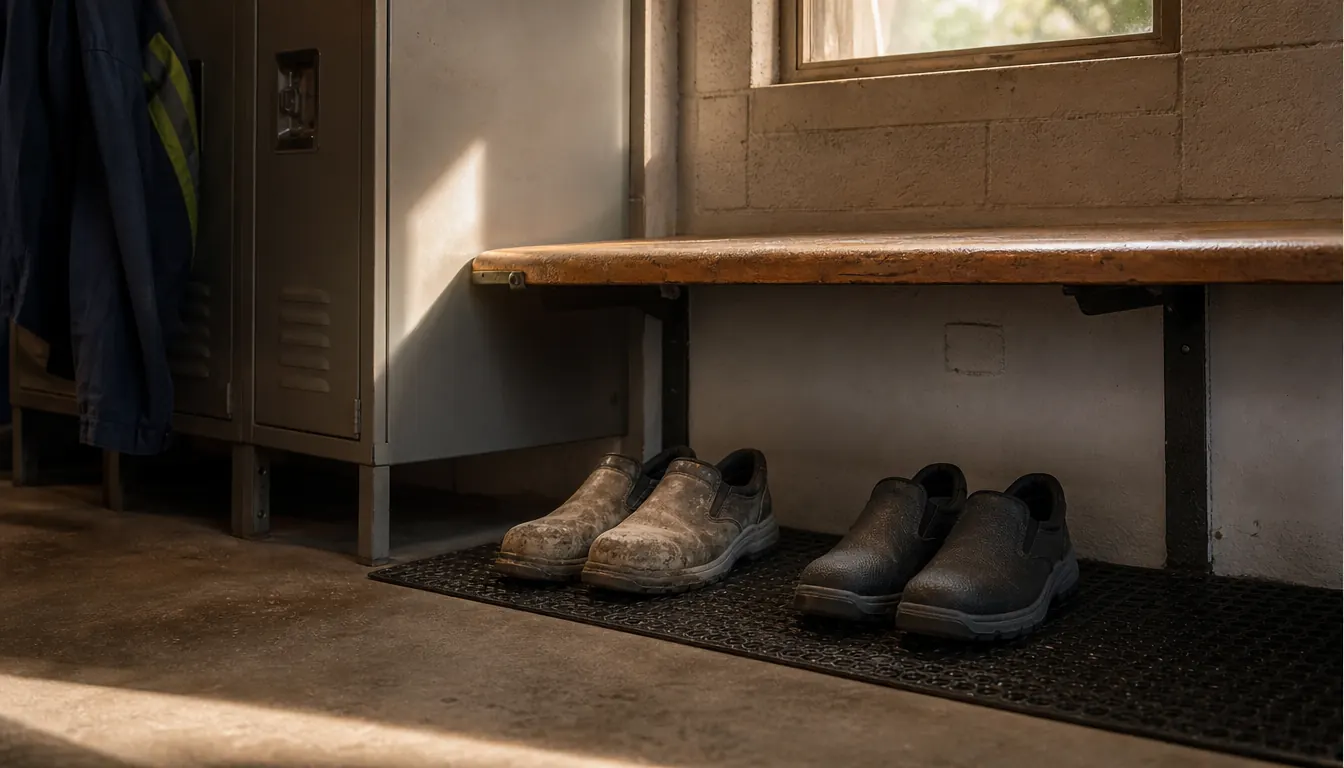
On my pairs, the insole compresses first, then the tread goes at the outside edge of the heel. That is where I land, so that is where they go. I get somewhere around five to seven months of five-day weeks out of a pair before they get demoted to yard work and the walk to the mailbox. That is not unusual for a work shoe, but it is worth saying out loud, because the cost of a shoe you replace twice a year is a different number than the one on the listing.
The water resistance fades too. It is a treatment, not a rubber boot, and after a few months of wiping them down and a winter of slush on the back dock, you will notice a splash soaking in where it used to bead up. Standing in a puddle is never a good idea in these. They are water resistant, not waterproof, and I would hate for anyone to learn that at 6 AM in the cooler with a case of lettuce in their arms.
Who This Is For
This is a good shoe for anyone who is on their feet for most of a shift on hard floors and who wants to step in and go. Grocery and retail staff, kitchen and deli workers, warehouse pickers, hairstylists, nurses on a unit with an unforgiving floor. It suits a wide or average forefoot. It suits somebody who does not want to bend over and deal with laces at 5 AM. And it suits somebody who wants a soft, forgiving ride rather than a firm, structured one.
It also suits the two-pair habit. Buy two, alternate them, let each pair dry out for a day, and the memory foam gets a rest between shifts. That single change did more for my feet than any one shoe did, and it is the cheapest thing you can do for yourself. If you are only going to own one pair, this is still a reasonable pick. You will just meet the flattening sooner than I do.
Who Should Skip It
Skip it if you need real structure under your arch for ten hours. The cushioning here is soft, and soft does not hold a tired foot up at 3 PM. Skip it if your foot is narrow enough to feel your heel moving around inside a roomy shoe. Skip it if you work somewhere genuinely wet, a dish pit or a meat room with standing water, because water resistant is not waterproof and no slip-on sneaker is the right answer in a room like that.
And skip it if you want a shoe that lasts a year. It will not. The memory foam is the trade you are making. You get a comfortable first four months and a decision to make in the sixth. If that trade sounds like a bad deal, buy a firmer work shoe with an insole you can swap out and accept that the first week will be less pleasant than this one. Both are honest choices. Just know which one you are making.
If you're on your feet all shift and you want to stop bending down to tie anything, start here
Pull-on, closed toe, slip resistant outsole, memory foam insole, about 2 pounds for the pair. Sizes move, so check what's available at today's price before you commit to a full shift in them.
Amazon Check Today's Price on Amazon →